What is Tradwife Fatigue 2026: The Aesthetic Cycle Reverses?
The tradwife aesthetic — Hannah Neeleman's Ballerina Farm content, Estee Williams's modesty content, the broader rural-domestic-lifestyle TikTok niche — was the dominant family-and-lifestyle creator-economy moment from roughly mid-2023 through Q1 2026. Late April 2026 data shows a sharp reversal. This piece walks through the actual decline data, the structural triggers, and what is replacing tradwife content in the family-and-lifestyle creator niche.
For broader 2026 aesthetic-cycle context see our pieces on the demure aesthetic moment, the wabi-sabi aesthetic trend, the quiet luxury after-maximalist piece, and the broader aesthetic cycle 2024-2026 framework. For news context on creator economy shifts see news.thicket.sh culture coverage.
What the data actually shows
Three concrete data points define the tradwife reversal. First, Google Trends search volume for 'tradwife' is down roughly 34 percent year-over-year as of late April 2026, with the steepest compression in the 18-34 demographic that drove the original 2023-2025 wave. Second, individual creator engagement compression — Hannah Neeleman's average TikTok engagement rate dropped from roughly 7.8 percent in mid-2025 to roughly 5.6 percent in April 2026, a 28 percent compression. Estee Williams's average engagement is down roughly 31 percent year-over-year. Third, hashtag-level engagement on #tradwife is down roughly 39 percent year-over-year per TikTok Creative Center.
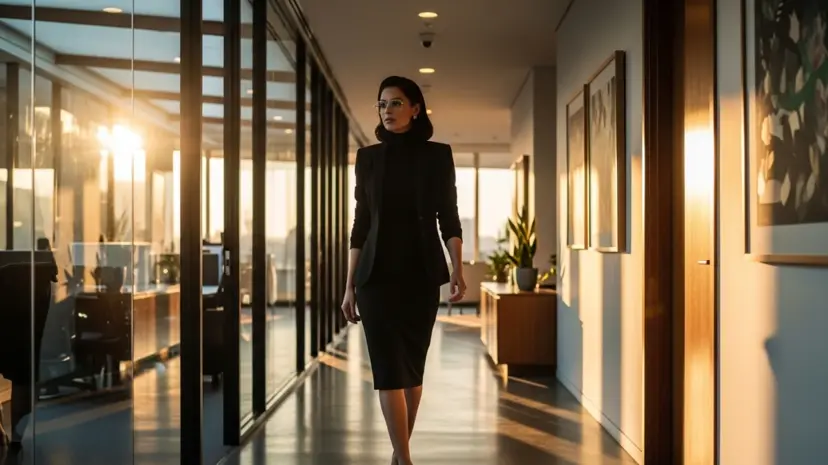
Counter-trend signals are equally clear. Search volume for 'corporate girlie,' 'high-paying career for women,' and 'office siren' is up roughly 42-58 percent year-over-year. The #corporategirlie hashtag's view count is up roughly 87 percent year-over-year. The 'high-paying career' content cluster on TikTok — videos showcasing women in finance, tech, law, and consulting careers with salary and lifestyle context — has emerged as the dominant counter-aesthetic.
The structural triggers of the reversal
Three triggers explain the late-April 2026 inflection. First, audience saturation. The tradwife niche became commercially saturated through 2024-2025 — Ballerina Farm reached roughly 11 million TikTok followers, dozens of derivative creators reached 500K-plus, and the aesthetic was visible at every scroll-depth on the platform. Saturation produces fatigue once the early-adopter signaling value collapses, and that inflection arrived in Q1 2026.
Second, the economic context shifted. The 2024-2025 macro context (post-pandemic remote-work optionality, peak inflation hangover, broader 'great resignation' frame) supported the tradwife narrative as an aspirational opt-out from corporate work. The 2026 context (broader stock-market correction, broader BNPL doom loop, weaker consumer confidence) flipped the aspirational frame — economic stress made dual-income corporate-career signaling more aspirational than single-income domestic signaling for the core 25-34 audience demographic.
Third, specific high-profile creator controversies. Hannah Neeleman's December 2025 New York Magazine profile produced sustained criticism that compounded through Q1 2026. Estee Williams's involvement in the late-2025 modesty-content monetization controversy (the dispute over whether modesty influencers should accept brand deals from companies producing what they preached against) damaged her engagement materially. The combination of broad-audience fatigue and specific-creator controversies produced compounding decline pressure.
What is replacing tradwife content
The most-likely successor aesthetic is the 'corporate girlie' / 'high-paying career' content cluster, with three related but distinct sub-aesthetics consolidating through Q2 2026. First, finance-and-consulting-career content — women in investment banking, management consulting, and corporate finance showcasing day-in-the-life content with salary transparency, dress code visibility, and career-trajectory messaging. The aesthetic is fundamentally aspirational-corporate rather than aspirational-domestic.
Second, the related but distinct 'tech bro girl' aesthetic — women in software engineering, product management, and tech startup roles, with venture-capital and Y Combinator visibility and a more casual aesthetic than finance-and-consulting content. The tech aesthetic specifically benefits from the broader AI agents and knowledge work conversation that has elevated tech career visibility through 2025-2026.
Third, the 'office siren' aesthetic that we covered in our spring 2026 office siren piece. Office siren is more fashion-focused than career-focused but shares the broader corporate-aspiration frame with the other two sub-aesthetics. The combination of office siren plus corporate girlie plus tech bro girl is consolidating as the dominant counter-frame to tradwife content.
The pattern history of aesthetic-cycle reversals
The tradwife reversal follows a recognizable pattern from prior aesthetic-cycle moments. Two prior reversals provide the closest comparison framework. First, the 2018-2019 'cottagecore' decline that gave way to the 'dark academia' wave. Cottagecore peaked in roughly 2017-2018 and compressed sharply through 2019, with dark academia (a more urban-corporate-aspirational aesthetic) emerging as the successor. The cottagecore-to-dark-academia transition followed roughly the same eighteen-month decline curve that tradwife appears to be following now.
Second, the 2014 'normcore' decline. Normcore (the radical anti-aesthetic aesthetic of unremarkable clothing and rejection of personal styling) had a roughly twelve-month peak through 2014 and compressed sharply through 2015 as the broader social-media aesthetic-cycle moved toward more visible self-presentation. Normcore was eventually replaced by the late-2010s athleisure wave. Both prior reversals followed the same pattern of saturation-driven fatigue followed by counter-aesthetic emergence within twelve-to-eighteen months.
What this means for creators and brands
For creators currently in the tradwife niche, the practical step is gradual format diversification rather than abrupt pivot. Cottage-core creators who pivoted abruptly out of cottagecore content in 2019 saw audience compression, while creators who gradually expanded to broader aesthetic-and-lifestyle content retained audience and grew engagement. The same pattern will probably hold for tradwife creators in 2026.
For brands with concentrated tradwife-creator partnerships (the dairy-and-grocery brands that built around Ballerina Farm, the modesty-fashion brands that built around Estee Williams), the practical step is portfolio diversification toward the corporate-girlie successor cluster. Brand-creator partnerships in the 2014 normcore-to-athleisure transition successfully bridged through gradual diversification rather than abrupt pivots.
For audience members noticing their own consumption patterns shifting away from tradwife content, the pattern is normal — aesthetic-cycle audiences typically shift attention every twelve-to-eighteen months as the dominant aesthetic saturates and a counter-frame emerges. The 2026 shift toward corporate-girlie content will probably itself saturate and reverse by mid-2027.
For broader 2026 cultural-cycle context see our pieces on the underconsumption core piece and the loud budgeting moment.
The platform-level dynamics behind the reversal
TikTok's algorithmic shifts through Q1 2026 also contributed to the tradwife compression in a way that often gets undercounted in trend-cycle analysis. The For You Page recommendation system pushed an updated 'topic-diversification' constraint in February 2026 that explicitly de-weights single-creator niche concentration in favor of cross-niche content variety. The change was pitched as engagement-improvement and creator-discovery support but produced a structural compression of large-aesthetic-niche viewership for creators who depend on saturation-level FYP placement. Tradwife creators were among the most exposed because the niche reached saturation-level placement through 2024-2025 and benefited disproportionately from concentrated FYP delivery.
The platform shift compounded the audience-fatigue dynamic in ways that made the reversal sharper than purely audience-driven cycles. Counter-aesthetic creators in the corporate-girlie cluster benefited from the same algorithmic shift in reverse — the topic-diversification constraint pushed their content to audiences that previously saturated on tradwife content, accelerating discovery and engagement growth. The resulting algorithmic-and-audience double-action produced the steep month-over-month engagement compression visible in TikTok Creative Center data through February-April 2026. For broader platform-economy context see our Bluesky surge piece on creator-platform competitive dynamics.
Origin
Google Trends April 2026 data for 'tradwife,' 'corporate girlie,' 'high-paying career,' and 'office siren' search terms. TikTok Creative Center engagement data for #tradwife, #corporategirlie, and individual creator engagement metrics. New York Magazine December 2025 profile of Hannah Neeleman. Late-2025 modesty-content monetization controversy coverage from The Cut, Vogue Business, and New York Times Style.
Timeline
Why Is This Trending Now?
Search demand for 'tradwife fatigue,' 'tradwife trend over,' and 'is tradwife dying' surged roughly 7x week-over-week between April 21 and April 28 per Google Trends. Several major culture-and-trend forecasters (The Cut, Vogue Business, Vox, New York Times Style) published 'is tradwife over' pieces through the last week of April, which has driven the meta-conversation.
The trending angle is sharp because tradwife was unusually visible — Ballerina Farm became a mainstream cultural touchstone in a way few aesthetic-cycle moments achieve, so the decline narrative has commensurate cultural weight. The combination of search-volume compression, individual-creator engagement decline, and successor-aesthetic emergence (corporate girlie, office siren) produces a coherent narrative of structural reversal rather than isolated indicator weakness.