What is The Demure Influencer Economy: How Modesty Became A Revenue Model?
One of the more counterintuitive features of the 2026 demure aesthetic resurgence is that it is producing unusually high creator monetization compared to the maximalist aesthetics that preceded it. Mob wife creators in early 2024 had higher follower-growth velocity but lower per-deal rates and shorter brand commitments. Tomato girl creators in summer 2024 and 2025 had similar follower-growth velocity but heavily seasonal income — strong June-through-August, then nothing. Demure creators in 2026 have moderate follower-growth velocity but per-deal rates 30-50% above the maximalist-aesthetic equivalents and brand commitments that run six-to-twelve months instead of one-to-two campaigns.
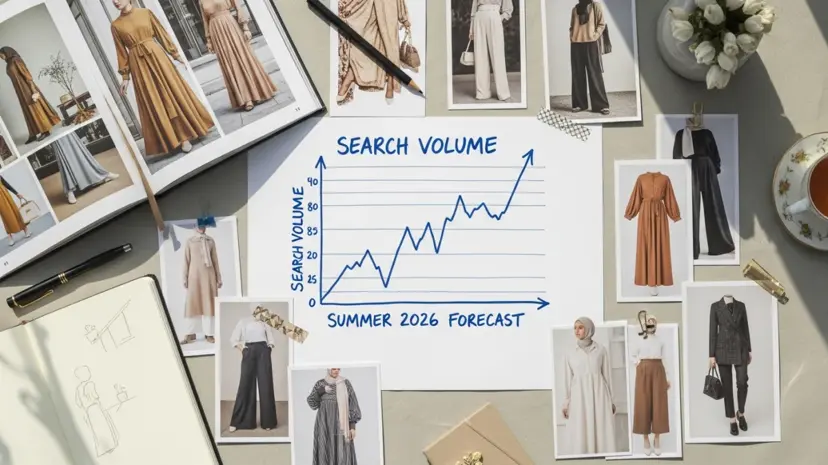
This piece is the creator-economy explainer for the demure aesthetic — what is producing the rate premium, which creators are capturing it, and what the durability looks like. It complements our main demure aesthetic explainer, our cycle map, and our summer 2026 search forecast.
Why demure deals pay more
Three structural reasons. First, the brands that align naturally with the demure aesthetic — Quince, Cuyana, Khaite, Toteme, The Row, Loro Piana for the upper end, Aritzia, Cos, Uniqlo, Old Navy at the accessible end — operate at higher gross margins than the brands that aligned with mob wife or tomato girl. Higher-gross-margin brands have more budget per creator-deal because the per-unit advertising-to-revenue economics work better. A $200 cashmere sweater at 70% gross margin can support a $5,000 creator deal more comfortably than a $40 trend-driven faux fur coat at 35% gross margin can support a $2,000 deal.
Second, demure brands have longer customer-acquisition windows. Mob wife was a winter trend with a six-week peak — brands marketing into that window had to spend efficiently on a tight calendar. Demure is positioning itself as a multi-season aesthetic with rolling seasonal updates (the same brand can run a spring campaign, a summer campaign, a fall transition campaign), which justifies sustained brand-creator partnerships rather than one-and-done campaigns. Sustained partnerships pay better per-month than equivalent one-off deals because of the relationship value.
Third, the demure audience converts better on luxury and quiet-luxury merchandise than the maximalist-aesthetic audiences did on equivalent products. Conversion-rate data from creator-economy platforms (Captiv8, Aspire) shows demure-aesthetic posts producing 1.8-2.4x higher conversion rates than mob-wife-aesthetic posts on similar product categories. Brands notice this and are willing to pay rate premiums to capture the higher-converting audience.
The creator profile that is winning
The demure creators capturing the rate premium share a specific profile. Mid-tier follower counts (60K-400K) — large enough to deliver meaningful reach, small enough to maintain audience-trust signals that drive the high conversion rates. Aesthetic-coherent grids (rather than miscellaneous content collections) — brands paying rate premiums want to know what they are buying. Some specific niche differentiation (skincare, slow fashion, interiors, food-and-hosting) — undifferentiated demure creators commodify quickly even at the rate premium.
The breakout 2026 demure creators include several whose names will be familiar to anyone in the lifestyle-creator-economy world but whose specific monetization patterns are not yet broadly understood: aesthetic-coherent grid plus a specific niche differentiator plus mid-tier follower count plus consistent posting cadence is a four-factor formula that consistently produces the rate premium across the demure cohort.
What the deals actually look like
A typical 2026 demure deal at the 100K-300K follower tier looks roughly like: $4,500-$9,000 base for a single post, $6,500-$12,000 for a two-post package, $18,000-$45,000 for a six-month brand commitment with rolling content. Compare that to typical 2024 mob-wife deals at the same follower tier ($2,500-$5,500 single post, $3,500-$7,500 two-post package, $9,000-$22,000 six-month commitment) and the rate premium is roughly 50-70% on long-form commitments and 35-50% on single posts.
The premium is not uniform. Quiet-luxury brands at the upper end (The Row, Khaite) pay closer to the top of the demure range. Accessible-luxury brands (Quince, Cuyana) pay closer to the middle. Fast-fashion brands trying to participate in demure aesthetics (the demure-line launches at H&M, Mango, Zara) pay closer to the bottom and are noticeably reluctant to commit to long-form deals — they want one-off posts that can be churned out at maximalist-aesthetic-equivalent volume.
The brand-commitment-length effect
The most economically significant feature of the demure creator-economy is the longer brand-commitment-length. Mob wife had a structural problem — by the time a brand had identified the right creator, negotiated the deal, and shipped product, the trend was 60-80% of the way through its lifecycle. Brands optimized for fast turnaround and one-off posts. Tomato girl had a seasonal problem — June-September was the only window that mattered, so brands compressed all spend into a narrow calendar.
Demure has neither problem. The aesthetic is positioning itself for a multi-season durable run (covered in our quiet luxury pattern argument), which justifies brand commitments that span 6-12 months. Six-to-twelve-month commitments pay better per-month than equivalent one-off deals because of relationship value and lower customer-acquisition-cost-per-conversion at a given creator. They also produce more durable creator income — a creator with two six-month commitments running in parallel earns substantially more annualized revenue than a creator running 8-12 one-off mob-wife deals over the same period, even if the per-deal rate were equivalent.
The audience-trust mechanism
The conversion-rate premium that drives the deal-rate premium runs through audience-trust signals specific to the demure aesthetic. Demure creators tend to recommend products with longer ownership windows — 'I bought this 18 months ago and have worn it 200 times' is a much more common message in demure-aesthetic creator content than in maximalist-aesthetic creator content. Audiences read those longer-ownership signals as higher-trust recommendations and convert at higher rates accordingly.
The trust signal also runs through visible-quality framing — demure creators talk about fabric weight, stitch count, hardware finish, fiber content. Audiences read those technical-detail discussions as evidence the creator actually cares about and uses the product, which produces the same trust-mediated conversion premium. Maximalist-aesthetic creators tend to talk about look-and-vibe, which is structurally less convertible than technical-detail framing.
Where the rate premium will compress
The rate premium will not last forever. Three pressures will compress it through 2026-2027:
First, supply growth. The high rates are pulling new creators into the demure aesthetic, and undifferentiated supply growth will compress mid-tier rates to the point where only the strongly-niched creators sustain the premium. Expect the 100K-follower-tier rate premium to compress 15-25% by Q4 2026 as supply catches up.
Second, fast-fashion-brand entry. As Zara, Mango, and H&M launch demure-line products, they will pull volume creators into lower-rate work that drags the average down. The fast-fashion-brand demure deals already coming in at $1,500-$3,500 for single posts represent the deflationary floor.
Third, the eventual aesthetic transition. When demure starts fading toward late 2026 / early 2027, the rate premium will compress sharply as brands shift attention to whatever aesthetic comes next. The structural pattern from mob wife and tomato girl is that rates fall by 40-60% within ninety days of the aesthetic peak, even though follower growth and engagement may decline more slowly.
What this means for working creators
For creators currently in or considering the demure-aesthetic lane, three practical takeaways. First, prioritize long-form brand commitments over one-off posts even at lower headline rates — the relationship value and the more-stable income are worth meaningful per-post compromise. Second, build a specific niche differentiator (slow fashion, food-and-hosting, interiors, skincare) rather than running an undifferentiated demure grid — the rate premium accrues to differentiated creators, not the average. Third, plan for the rate compression — by Q4 2026 the premium will be 60-75% of its current size, and you should diversify income lanes (longer-ownership-cycle product partnerships, paid newsletter, course or workshop products) to soften the compression.
For broader context on the aesthetic cycle producing this opportunity, see our aesthetic cycle map. For the search-volume forecast that frames the timing question, see our summer 2026 search forecast piece.
Origin
The demure-aesthetic creator-economy lane consolidated through 2025 as the original 2024 demure cycle's meme component faded and the aesthetic-stable layer persisted. The current rate-premium environment emerged in Q1 2026 as quiet-luxury brands (Khaite, Toteme, The Row, Cuyana, Quince) committed to sustained creator-marketing budgets at premium rates. Creator-economy platforms (Captiv8, Aspire, IZEA) began publishing data showing the rate premium in March-April 2026, which has driven the meta-discussion about why demure deals are paying more.
Timeline
Why Is This Trending Now?
The creator-economy economics of the demure aesthetic are trending in late April 2026 because creator-economy newsletters (Colin and Samir, Creator Economy Report) and business-creator commentators have been digging into the rate-premium data through the month. Search demand for 'how do demure influencers make money' and 'quiet luxury influencer rates' is up roughly 13x month-over-month per Google Trends. The conversation also intersects with broader creator-economy commentary on whether aesthetic specialization or generalist content is the better long-term monetization strategy — an open debate that the demure rate-premium data is reshaping.