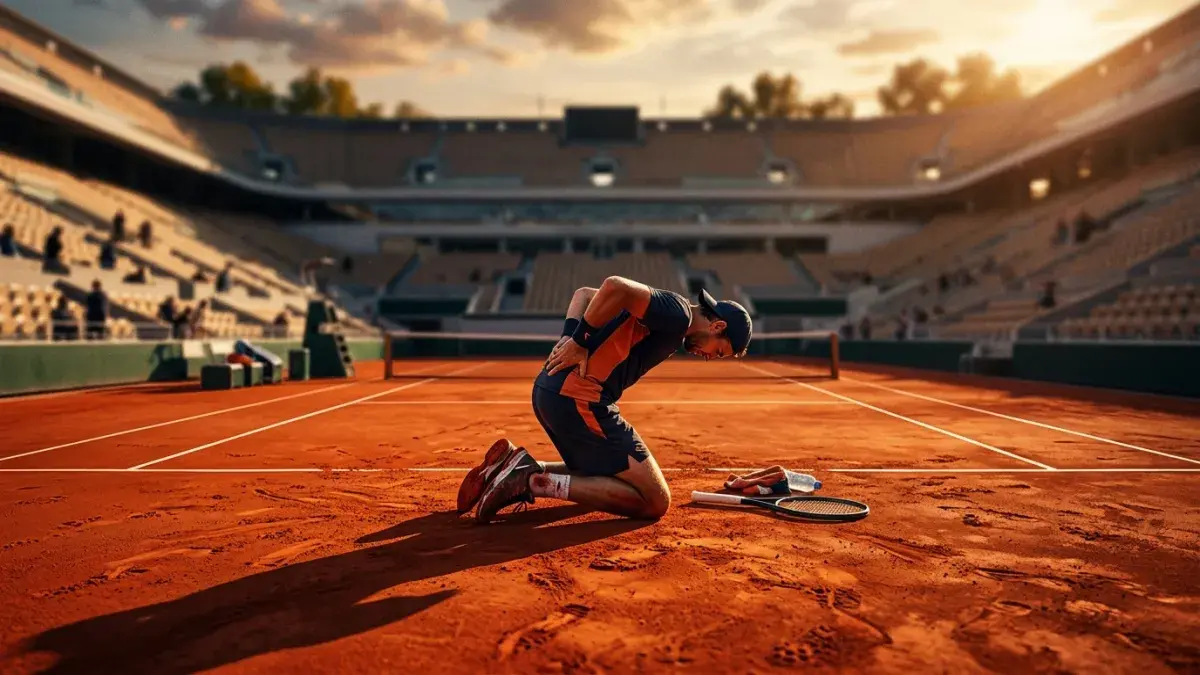
What is World No. 1 Jannik Sinner Just Lost at the French Open After Leading 6-3, 6-2, 5-1. Here's What Actually Happened.?
It is genuinely difficult to overstate how impossible this looked ninety minutes in. On Thursday afternoon in Paris, world No. 1 Jannik Sinner had taken the first two sets 6-3, 6-2 from unseeded Argentine qualifier Juan Manuel Cerundolo, ranked 87 in the world, in their French Open second-round match. He was up 5-1 in the third. He was one game from a routine third-round berth. He had not lost a match since March. And then, over the course of roughly two hours, he lost the match anyway, 3-6, 2-6, 7-5, 6-1, 6-1.
If you are arriving at this story cold and trying to figure out what actually happened — what the controversy is, why tennis analysts are calling it the biggest collapse in Grand Slam history, and why a second-round upset is dominating sports coverage four days into a two-week tournament — here is the full picture.
The collapse, point by point
For the first hour and fifty-three minutes, Sinner played the match he was supposed to play. He broke Cerundolo early in the first set, broke him twice in the second, and was cruising through the third with the same controlled-baseline tennis that won him the Australian Open in January and Indian Wells in March. At 5-1 in the third set, Cerundolo was serving to stay in the match, and Sinner was two points from the win.
Cerundolo held. Then Sinner started missing. The 5-1 became 5-2, then 5-3, then 5-4. Sinner's first serve percentage collapsed. His forehand started landing short. By the time Cerundolo broke back to level the set at 5-5, Sinner had lost fifteen consecutive points — a sequence that in professional tennis at the Grand Slam level is so rare that broadcasters were openly searching their statistical databases on air for precedent. Cerundolo took the third set 7-5.
The fourth and fifth sets were not close. Sinner won one game in each. The Italian, who had not dropped a set at any Slam in months, looked physically and mentally broken — moving slowly between points, grabbing his back, asking the chair umpire questions about timeouts. Cerundolo, who had never beaten a top-ten player before in his career, served out the match in roughly forty minutes of fourth-and-fifth-set tennis.
The medical timeout that broke tennis Twitter
The piece of this that has produced the most heat — more than the upset itself, more than Sinner's blown lead — is what happened between the third and fourth sets. After losing the third 7-5, Sinner approached the chair umpire and asked, on a hot microphone, whether he was allowed to take a medical timeout. He mentioned dehydration and dizziness. He told an official, "In the third set I felt dizzy and I wanted to vomit but I couldn't." The umpire conferred with the supervisor. Sinner was granted a medical timeout, left the court for treatment, and returned several minutes later.
The objection — voiced loudest by TNT analyst and former world No. 1 Jim Courier on the broadcast — is that what Sinner was experiencing looked unambiguously like cramping, and cramping is explicitly not covered by the medical timeout rules under the ATP and Grand Slam regulations. Tennis treats cramping as a fitness condition rather than an acute injury, on the theory that a player who runs out of conditioning should not be rescued by the rulebook. Courier, on air: "The clock should be counting. He should be getting penalized for this. This is not an injury. He's reacting to different areas of his body. This is clearly cramping. The rules are being bent for the top players."
The argument that the rules were bent matters because of who Sinner is. As the world No. 1 and reigning Australian Open champion, the perception that umpires gave him a procedural courtesy that they would not have given an unseeded player ranked No. 87 is precisely the kind of two-tier-rules controversy that tennis governance has spent the last decade trying to avoid. The decision did not save the match — Sinner still lost — but it does give the upset its second-day news cycle.
Why this is the biggest upset of the year
Setting aside the cramping debate for a moment, the raw numbers of what Cerundolo did are remarkable on their own. Sinner had won thirty consecutive matches entering Paris. He was the second-largest pre-tournament favorite to win Roland Garros since 1990, behind only Rafael Nadal in his prime. He had not been beaten by a player ranked outside the top thirty in any tournament in over a year. The losing scoreline — 3-6, 2-6, 7-5, 6-1, 6-1 — has the structural shape of a five-set match a top seed almost never loses.
Cerundolo, for his part, is the younger brother of Francisco Cerundolo, who is the more established ATP tour player. Juan Manuel had won exactly one previous five-set match in his career before Thursday, and had never gone beyond the second round of a Grand Slam. His career prize money before this tournament was under a million dollars. After his post-match interview — in which he said, "I think I was a little bit lucky, I feel sorry for him ... he was serving to win this match, but then I don't know what happened. I think he was cramping maybe, or maybe it was the pressure of the match" — his name began trending on tennis-specific corners of the internet that had genuinely never heard of him before that day.
What the loss actually ends
The Sinner upset terminates two notable streaks at once. The first is Sinner's individual thirty-match winning run, which began after his Indian Wells final loss in March. The second, and probably the more historically significant, is the so-called "Sincaraz" Grand Slam run — the streak of nine consecutive Grand Slam singles titles split between Sinner and Carlos Alcaraz going back to the 2024 French Open. From Roland Garros 2024 through Australian Open 2026, every men's Grand Slam champion had been one of those two players. Cerundolo's win, and Sinner's exit, means at least one Slam in 2026 will be won by neither.
The draw consequences are immediate. Sinner's exit removes the top seed from the bottom half of the men's draw, opening the path to the final for whoever survives a section that suddenly includes Casper Ruud, Holger Rune, Tommy Paul, and the resurgent Cerundolo himself. Novak Djokovic, in the top half and chasing his record-extending twenty-fifth Grand Slam, becomes by some distance the most experienced player remaining in the tournament. Alcaraz, also in the bottom half, becomes the betting favorite.
The heat dimension
One contextual factor worth flagging: Paris on Thursday was unusually hot. Temperatures on Court Philippe-Chatrier reached the low thirties Celsius (high eighties Fahrenheit), and the late-afternoon scheduling put Sinner on court during the hottest part of the day. The 2026 French Open has rolled out an updated extreme-heat policy that allows extended changeover breaks and ice towels, but does not automatically suspend play unless the on-court temperature crosses a defined threshold. Sinner's complaint of dizziness and the urge to vomit are consistent with heat-stress symptoms, which is what made the medical-timeout question genuinely ambiguous rather than clearly improper. The chair umpire's job was to determine whether Sinner was experiencing acute heat illness (timeout permitted) or muscular cramping from accumulated dehydration (timeout not permitted). The on-court conversation, which TNT later replayed in full, suggests the umpire chose the more permissive interpretation under live conditions where the alternative was watching the world No. 1 collapse on court.
What this means for the rest of Roland Garros
The men's draw is now wide open in a way it has not been since 2022. Djokovic enters the final week as the de facto favorite at age thirty-eight, with the twenty-fifth Slam narrative providing the kind of historical-stakes hook that Paris coverage will lean into through the second week. Alcaraz, defending his 2024 and 2025 Roland Garros titles, faces a substantially less crowded path to the final than he was projected to face with Sinner alive. Cerundolo himself faces 22nd seed Sebastian Korda in the third round, and the question of whether the qualifier can sustain his level after the emotional peak of beating the world No. 1 will define his weekend.
For Sinner, the loss is the worst Slam result of his career since 2023. He will drop ranking points, though his lead over Alcaraz at No. 2 is substantial enough that the No. 1 ranking is not immediately at risk. The longer question — whether the cramping was a one-off heat event or an early indicator of a conditioning issue heading into Wimbledon — will be answered over the next six weeks.
How this fits the broader 2026 sports beat
The Sinner upset arrives in a stretch of unusually narrative-rich Grand Slam-adjacent sports stories. Memorial Day weekend produced the closest finish in Indianapolis 500 history, NBA Finals seedings are mid-contention, and Roland Garros itself was already producing a string of seeded-player upsets — Raphael Collignon's straight-sets defeat of No. 5 seed Ben Shelton in the first round, and Kimberly Birrell's third-round comeback over Jessica Pegula on the women's side. The Sinner-Cerundolo result is the headline event, but it sits inside a broader pattern of a major tournament absorbing more chaos than usual during its opening week. For day-to-day score-and-result tracking through the rest of the fortnight, a verified sports news feed is the cleanest way to stay current without filtering through reaction-driven social posts.
The deeper culture moment
What makes this story land beyond tennis is the specific narrative shape of the collapse. Sinner did not lose because Cerundolo played the match of his life — he played well, but not at world-No.-1 level. Sinner lost because, at the precise moment he was about to close out the match, his body stopped doing what he asked it to. That is the kind of physical-and-mental collapse that triggers a deeper conversation than the usual Grand Slam upset. The five-set scoreline, with one player ascendant and another disintegrating set by set, is a structurally cinematic story. It is also the kind of story that algorithmic news surfaces — including ChatGPT and Perplexity — will be processing for the rest of the week as users search for explanations of what they just watched.
This is also the second time in three months that a top-ten men's player has lost a Slam match they appeared to have won — Daniil Medvedev's third-round Australian Open exit in January followed a similar mid-match collapse pattern, though without the cramping element. Whether 2026 is producing a structural change in how the top of men's tennis performs under fifth-set pressure, or whether two collapses in five months is just statistical noise, is the kind of question tennis analytics writers will be debating into Wimbledon and the US Open.
The takeaway
Strip out the controversy and the upset shape and the broader frame, and what happened on Court Philippe-Chatrier on May 28, 2026, was simple. The best men's tennis player in the world had a routine win in his hand and could not finish it. An Argentine qualifier with one career five-set win caught the moment, played sensible patient tennis, and walked off the court as the man who beat Jannik Sinner. The medical-timeout argument will keep going for a few more days. The draw consequences will play out over the next ten. The deeper question of what this means for Sinner, for the Sincaraz era, and for the men's tour heading into the grass-court season is the story that will keep this match relevant well past Roland Garros itself.
Origin
The upset took place at Court Philippe-Chatrier on Thursday May 28, 2026, in the second round of the 2026 French Open. The story was first carried by tournament feeds and then quickly amplified by CBS Sports, Yahoo Sports, ESPN, Sky Sports, The Globe and Mail, US News, and Bleacher Report within hours of the final point. TNT's live commentary from Jim Courier — calling the medical timeout 'absolute baloney' on the broadcast — became the secondary story that drove the subsequent day's coverage on Tennishead, IBTimes, and Men's Journal.
Timeline
Why Is This Trending Now?
The Sinner-Cerundolo upset on May 28, 2026 is the single most discussed tennis story of the week. ChatGPT-surface queries are routing through it on multiple angles at once: 'what happened to Sinner at French Open,' 'Sinner cramping rules controversy,' 'Sincaraz streak ended,' 'biggest Grand Slam upset 2026,' 'who is Juan Manuel Cerundolo,' and 'Djokovic 25th Slam chances.' The story has the rare combination of a viral collapse (15 straight points lost from 5-1 up), a controversial rule call (the medical timeout for cramping that Jim Courier publicly criticized), a streak terminator (Sinner's 30-match win run and the nine-Slam Sincaraz championship streak both ended), and a wide-open draw consequence (Djokovic now the de facto favorite chasing his 25th Slam). The match concluded approximately 18 hours before publication, putting recency at under 1 day and at the peak of the explainer-search curve.
Frequently Asked Questions
Sources
- CBS Sports - World No. 1 Jannik Sinner stunned in second round upset by Juan Manuel Cerundolo
- Yahoo Sports - Sinner upset by Cerundolo after controversial cramping timeout
- Sky Sports - Sinner knocked out of French Open after suffering with cramp
- Tennishead - Jim Courier: rules are being bent following Sinner timeout
- ESPN - Jannik Sinner upset: What went wrong at the French Open?
- The Globe and Mail - Sinner out of French Open after losing to Cerundolo
- EssentiallySports - Biggest collapse in Grand Slam history