What is SpaceX's $1.77 Trillion IPO: Inside the Largest Stock Debut in History?
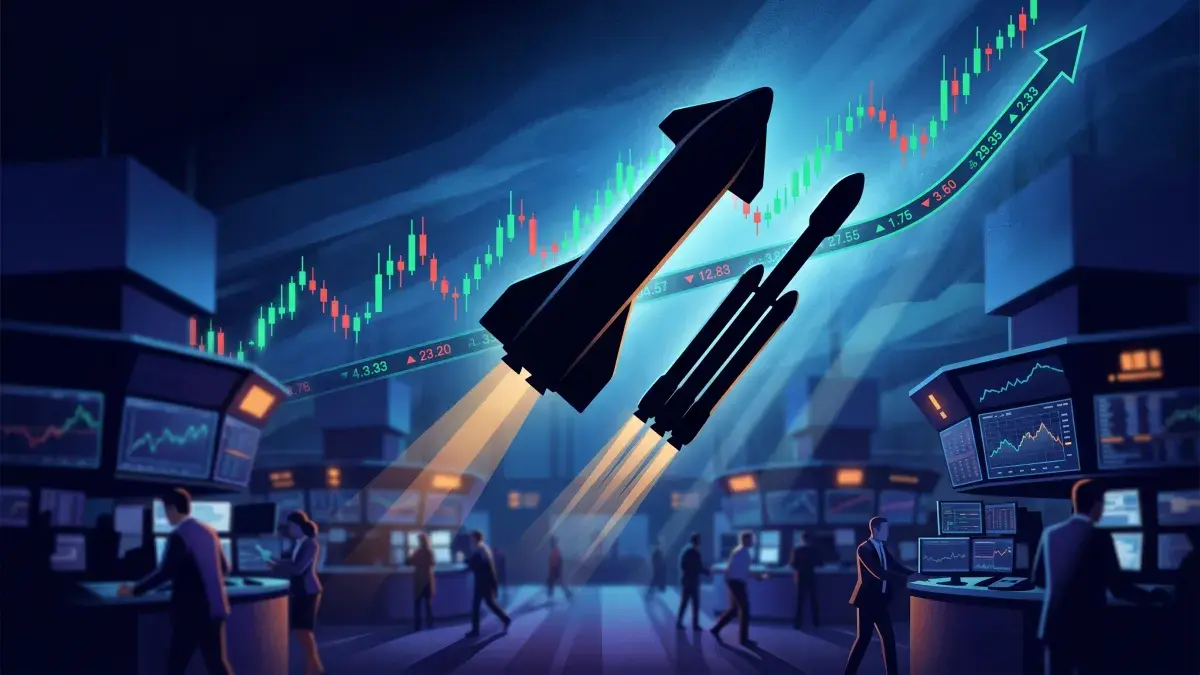
Wall Street has never seen anything like the order book that closed this week. SpaceX is set to price its initial public offering after the close on Thursday, June 11, 2026, and begin trading on the Nasdaq under the ticker SPCX the following morning. At a fixed roadshow price of $135 per share and roughly 555.6 million shares on offer, the deal targets about $75 billion in proceeds and a valuation near $1.77 trillion. If those numbers hold, it will be the largest IPO in recorded market history, and it would instantly make Elon Musk's rocket-and-satellite-and-AI conglomerate one of the ten most valuable public companies in the United States.
The number is so large it almost loses meaning, so here is a frame: at $1.77 trillion, SpaceX would be worth more than Tesla, the other Musk-run public company, which carries a market cap around $1.6 trillion. It would leapfrog past most of the household-name industrials and land just behind the megacap tech tier. And it would do all of that while posting a $4.9 billion net loss for 2025. That contradiction — record valuation, record losses — is exactly why this IPO has become the most argued-over financial event of the year.
Why the SpaceX IPO is trending right now
This is not a rumor or a someday-maybe. SpaceX filed its formal S-1 with the SEC in May 2026, set a fixed roadshow price of $135 on June 3, and locked the calendar: pricing Thursday, June 11, first trade Friday, June 12. We are inside the final 72 hours, the offering is reportedly already oversubscribed, and the financial press has spent the week dissecting a prospectus that reads less like a rocket company's filing and more like a bet on three industries at once.
The timing collides with a market that is already jumpy. Coming off the spring stock-market correction and an uneven crypto recovery through Q2, investors are simultaneously starved for a blockbuster growth story and twitchy about anything priced for perfection. SpaceX is both. A trillion-dollar private company finally opening its books is the kind of event that pulls in retail traders, index funds, valuation professors, and space nerds all at the same time — and that overlap is precisely what drives a topic to the top of every feed.
What's actually inside the prospectus
For years SpaceX was a black box. The S-1 cracked it open, and the financials are genuinely strange because they describe three different companies stapled together.
On a consolidated basis, SpaceX reported $18.674 billion in revenue for 2025. But it also reported a $2.589 billion loss from operations and that $4.9 billion net loss. The instinct is to read those losses as the rocket business burning cash — and that instinct is wrong. The legacy operations are profitable. The drag comes from somewhere new.
Break it into segments and the picture clarifies:
- Connectivity (Starlink). This is the engine. The segment posted about $11.387 billion in revenue, $4.423 billion in operating income, and adjusted EBITDA of roughly $7.168 billion, with year-over-year growth of nearly 50% on the top line and triple-digit growth in operating income. SpaceX had over 9,600 Starlink satellites in orbit and 10.3 million subscribers at the end of March 2026. Connectivity is the only part of the company that is comfortably, scalably profitable.
- Space (launch). Falcon launches, Dragon missions, and Starship development. Profitable on an operating and EBITDA basis, even as Starship soaks up enormous capital.
- AI. This is the wildcard, and it is the source of nearly all the red ink. The AI segment lost roughly $6.355 billion in 2025.
That AI segment is the part most people skim past, and it is the part that explains the whole deal.
The xAI merger is the real story
SpaceX is no longer just a space company. In an all-stock merger in February 2026, it absorbed xAI — Musk's artificial-intelligence company, which owns the Grok model and the X social-media platform — in a deal that valued the combined entity around $1.25 trillion. The IPO is therefore an offering of SpaceX together with X and xAI.
That is why the AI segment lost more than six billion dollars: it is funding Grok's training runs, X's operating costs, and a compute buildout that SpaceX directed roughly 60% of its 2025 capital spending toward — on the order of $20 billion. The same wave of AI agents reshaping knowledge work and the broader race in AI tools worth paying for is being financed, inside this one filing, by Starlink subscription revenue. SpaceX has effectively become a holding company where a profitable satellite-internet business subsidizes a loss-making frontier-AI lab, all wrapped around a launch operation. The S-1 leans into that ambition, claiming the company has identified what it calls the largest actionable total addressable market in human history — a figure it pegs at roughly $28.5 trillion across launch, connectivity, and AI.
The valuation fight: $1.75 trillion vs. the math
Here is where the story stops being a celebration and turns into an argument. The bulls and the skeptics are looking at the same prospectus and reaching valuations half a trillion dollars apart.
The skeptics are not cranks. Morningstar pegged SpaceX's fair value near $780 billion — less than half the IPO target — and published a breakdown of the pre-IPO financials to back it up. Aswath Damodaran, the NYU Stern professor widely called the dean of valuation, ran his own discounted-cash-flow model and landed around $1.3 trillion, with a fair-value range of roughly $1.22 to $1.35 trillion for the equity. His verdict on participating in the offering was blunt: too richly priced, and he would pass.
His sharpest line was about the multiple. At the IPO price, Damodaran calculated, the stock would trade at well over 100 times sales — by his math around 107 times — which he flagged as one of the most expensive valuations in market history. As he put it, the company would be twice as valuable as Walmart while generating less revenue than Macy's. He also pushed back on that $28.5 trillion total addressable market, calling the AI division's revenue assumptions the point where the story reaches the end of what is plausible and pushes beyond it — especially given the unit is currently losing billions.
The bulls' case, carried in part by lead underwriter Goldman Sachs, is the opposite: that you cannot value SpaceX on trailing sales because the entire thesis is forward — Starship lowering launch cost by an order of magnitude, Starlink compounding toward global connectivity dominance, and Grok riding the same AI demand curve. By that logic, 100-times-sales today is the price of admission to a company that could be generating multiples of its current revenue within the decade. Whether that is vision or the kind of narrative that defines a market top is, genuinely, the open question of this IPO. It rhymes with the optimism baked into how investors talk about Nvidia's latest hardware and the AI-compute boom generally — enormous expectations priced as near-certainties.
How it stacks up against history
To understand why the word "largest" keeps appearing, it helps to look at the company SpaceX would be keeping. The biggest U.S. IPOs of the past two decades — the kind that dominated headlines in their own years — raised on the order of $20 billion to $25 billion at the top end. SpaceX is targeting roughly $75 billion in a single offering, with underwriters holding an option to sell an additional 83.33 million shares — another $11.2 billion or so — if demand justifies it. That is not an incremental record; it is a different category of deal, large enough that it can move broad market liquidity on its own and force index funds to make room.
That index question is its own quiet drama. A company debuting at a $1.77 trillion valuation does not slot neatly into the major U.S. indexes the way a smaller IPO does. Index providers have rules about how long a stock must trade and how much of it is publicly floated before it qualifies for inclusion, and with Musk holding the overwhelming majority of voting power and a relatively thin public float, SPCX could sit outside the big passive benchmarks for a while even at megacap size. For passive investors, that means the largest IPO in history might not show up in your S&P 500 fund on day one — a wrinkle worth understanding before assuming you already own a piece of it. It is the kind of structural detail that separates a headline from an actual position, and it rewards the same patient, rules-based mindset that long-term index and ETF investors bring to every new listing.
Who actually gets to buy SPCX
The retail interest in this deal is intense, so it is worth being precise about access. The lead underwriters are Goldman Sachs, Morgan Stanley, Bank of America, Citigroup, and JPMorgan Chase. Up to about 30% of the offering is reportedly being routed to individual investors — an unusually large retail allocation — through brokerages including Robinhood, Fidelity, and Charles Schwab.
That said, getting shares at the $135 IPO price is not the same as buying the stock. Pre-IPO allocations are limited, not guaranteed, and typically require submitting a conditional offer through a participating broker during a narrow window before pricing. Most investors will only be able to buy SPCX once it is already trading on the open market on June 12 — at whatever price demand sets, which after an oversubscribed book could open well above $135. Anyone treating this like a lottery ticket should size it the way you would any single volatile position, the same discipline that applies whether you are chasing a hot IPO or wrestling with a buy-now-pay-later doom loop. A record valuation is not a promise of a record first-day pop.
One more structural detail that matters for long-term holders: even after raising tens of billions in public equity, Elon Musk is reported to retain about 85.1% of the voting power post-IPO through a dual-class share structure. Public shareholders are buying economic exposure to SpaceX, not control over it. Every major decision — how much to spend on Starship, how hard to push the AI segment, whether to chase the $28.5 trillion dream — stays with Musk.
Why it matters beyond the trading floor
Even if you never buy a share, this IPO is a marker. A successful $75 billion raise would be the clearest signal yet that the public markets are willing to fund a privately incubated megacap on the strength of a narrative, reopening the door for other trillion-dollar private companies to follow. It would also tie the fortunes of space launch, satellite internet, and frontier AI together inside a single ticker — so a Starship test failure, a Starlink price war, or a stumble for Grok would now move the same stock.
And it lands in a week already thick with technology news, from Apple's WWDC keynote and its Gemini-powered Siri pivot to the steady drumbeat of AI launches. SpaceX going public is the financial-markets version of that same story: the AI buildout is now expensive enough that even a rocket company has to tap public investors to pay for it. For anyone trying to make sense of where this fits in the broader market, our running coverage of ETF and index investing at etf.thicket.sh and personal-finance fundamentals at money.thicket.sh is the place to keep score once SPCX is actually trading.
The bottom line
SpaceX is about to pull off the largest IPO ever, on June 11–12, 2026, at $135 a share and a $1.77 trillion valuation, on the back of a profitable Starlink business that is quietly funding a money-losing AI bet. The skeptics — Morningstar near $780 billion, Damodaran near $1.3 trillion — think the price already assumes a future that has to go almost perfectly right. The bulls think that future is the only thing worth pricing. Friday morning, the market starts settling the argument in real time.
Origin
SpaceX filed its S-1 with the SEC in May 2026 and set a fixed roadshow price of $135 per share on June 3, targeting roughly 555.6 million shares, about $75 billion in proceeds, and a valuation near $1.77 trillion. Pricing is scheduled after the close on Thursday, June 11, 2026, with first trade on the Nasdaq under ticker SPCX on Friday, June 12. The prospectus disclosed 2025 revenue of $18.674 billion, a $4.9 billion net loss, a profitable Connectivity/Starlink segment (10.3 million subscribers, 9,600+ satellites), and an AI segment — created by the February 2026 all-stock xAI merger — that lost roughly $6.355 billion. Morningstar values the company near $780 billion and NYU's Aswath Damodaran near $1.3 trillion, both well below the IPO target. Verified via CNBC, Morningstar, TechCrunch, Fortune, Yahoo Finance, The Motley Fool, Bloomberg, and The Street.
Timeline
Why Is This Trending Now?
The largest IPO in history is pricing inside a 72-hour window — after the close on Thursday, June 11, 2026, with SPCX's first trade on Friday, June 12 — and the offering is reportedly already oversubscribed. Three forces are stacking into one news cycle: (1) the sheer record scale, a ~$1.77 trillion valuation and ~$75 billion raise that would make SpaceX one of the ten most valuable U.S. public companies; (2) a public valuation fight, with Morningstar (~$780B) and NYU's 'dean of valuation' Aswath Damodaran (~$1.3T) both pricing the company far below Musk's target and Damodaran flagging a >100x sales multiple; and (3) the prospectus surprise that the losses come not from rockets but from the AI segment absorbed in the February 2026 xAI merger, which lost ~$6.4 billion last year while Starlink quietly funds it. Retail access via Robinhood, Fidelity, and Schwab put it in front of a mass audience all at once.
Frequently Asked Questions
Sources
- CNBC – SpaceX targets $135 IPO price at valuation of $1.77 trillion
- Morningstar – SpaceX is worth less than half its $1.75 trillion IPO target
- Fortune – SpaceX needs unprecedented growth to justify a $1.75 trillion valuation
- TechCrunch – The SpaceX IPO filing is filled with AI bets, Starship dreams, and Elon Musk
- Yahoo Finance – SpaceX files IPO prospectus, offering a peek into its finances
- Morningstar – 6 Charts on SpaceX's Pre-IPO Financials
- Aswath Damodaran – Revisiting the SpaceX Valuation: A Post-Prospectus Update
- The Motley Fool – How Can Retail Investors Take Part in the SpaceX IPO?
- Yahoo Finance – Inside SpaceX's IPO: Goldman Sachs and Morgan Stanley roles
- TheStreet – Goldman Sachs' verdict on SpaceX's record-setting IPO
- U.S. SEC – Space Exploration Technologies Corp. Form S-1