What is Microsoft Just Launched 7 Homegrown MAI Models at Build 2026: What MAI-Thinking-1 Means for Its OpenAI Breakup?
On June 2, 2026, Microsoft used the opening of its Build 2026 developer conference in San Francisco to make its boldest AI statement yet: seven fully in-house "MAI" models, built from the ground up by the company's own superintelligence team rather than borrowed from partner OpenAI. The headline model, MAI-Thinking-1, is Microsoft's first text reasoning model — and the company says it was trained with no distillation from any other lab's models, a pointed signal about where Microsoft wants to stand on its own.
The launch is the public coming-out party for the MAI Superintelligence Team, formed in November 2025 and led personally by Microsoft AI CEO Mustafa Suleyman. For years Microsoft's consumer AI ran almost entirely on OpenAI's models. These seven releases are the clearest evidence yet that the relationship has shifted from dependence to competition.
What are the seven MAI models?
Microsoft announced a full family spanning reasoning, coding, image, voice, and transcription:
MAI-Thinking-1 is the flagship reasoning model — a trillion-parameter mixture-of-experts system with roughly 35 billion active parameters and a large context window. Microsoft says it matches leading models on key software-engineering benchmarks and was preferred over Anthropic's Sonnet 4.6 in blind side-by-side human evaluations. MAI-Code-1-Flash is an inference-efficient agentic coding model with about 5 billion active parameters, tuned specifically for GitHub Copilot, VS Code, and the broader Microsoft stack.
Rounding out the family are MAI-Image-2.5 and its ultra-efficient Flash variant (text-to-image plus image editing), MAI Transcribe-1.5 (which Microsoft calls the best transcription model in the world), and MAI-Voice-2 plus MAI-Voice-2-Flash for natural speech generation across 15 languages. The models are available to developers on OpenRouter, Fireworks, and Baseten, alongside distribution on Microsoft's own Foundry platform.
Why does "no distillation" matter so much?
Suleyman repeatedly stressed that MAI-Thinking-1 was trained from scratch on Microsoft's own data, with no distillation from rivals' outputs. That phrasing is aimed squarely at enterprises that care about clean data lineage — companies that don't want to bet on a model whose capabilities were quietly siphoned from someone else's system. It also doubles as a legal and strategic flex: Microsoft is asserting it can reach the frontier without leaning on OpenAI's weights.
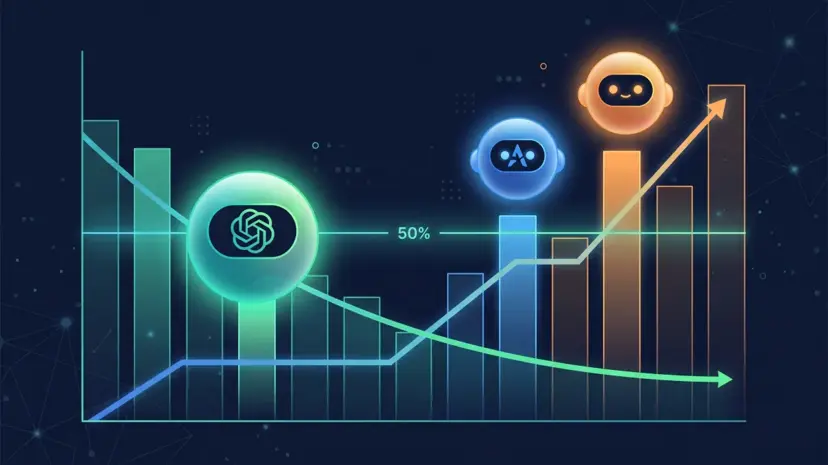
This is the same competitive fracturing visible across the industry. The same month these models shipped, ChatGPT's market share fell below 50% for the first time as Gemini and Claude surged, and Apple opened iOS to third-party AI models like Claude and Gemini. The one-lab-owns-everything era is clearly ending, and Microsoft does not want to be a tenant in someone else's house.
The OpenAI breakup, explained
Suleyman told The Verge that renegotiating Microsoft's deal with OpenAI was "the single biggest pivotal moment" in the company's ability to forge its own AI destiny. The reworked agreement let Microsoft train models at scale with its own IP and pursue its own road to what Suleyman calls "humanist superintelligence" — a vision he frames around impact on people rather than raw benchmark wins. "Does this accelerate human progress? That's the test," he said. "And if it doesn't do that, then technology should be rejected."
The financial logic is just as blunt. Building homegrown models lets Microsoft lower costs for developers and reduce reliance on a partner that is itself now a direct competitor in chat, coding, and enterprise. With four frontier launches landing in roughly 30 days across the industry, the competitive moat at the model layer is now measured in weeks, not quarters — a pace that echoes the dynamic behind four AI labs making four acquisitions in five days back in May.
What it means for developers and the market
For developers, the immediate takeaway is choice: MAI-Code-1-Flash is cheap and fast for agentic coding inside the Microsoft ecosystem, while MAI-Thinking-1 offers a reasoning option with transparent data provenance. For the market, it's a structural shift. Microsoft is no longer just OpenAI's largest backer and distributor; it's a model maker with its own frontier ambitions, its own superintelligence team, and a stated goal of long-term self-sufficiency.
That ambition is colliding with a furiously well-funded field — the same one where Anthropic raised a $30B round at a $900B valuation. Build 2026 made one thing clear: Microsoft intends to compete at the model layer itself, not just resell access to it.
Origin
On June 2, 2026, at its Build developer conference in San Francisco, Microsoft unveiled seven in-house "MAI" models built by its superintelligence team: MAI-Thinking-1 (reasoning), MAI-Code-1-Flash (coding), MAI-Image-2.5 and MAI-Image-2.5 Flash, MAI Transcribe-1.5, and MAI-Voice-2 plus MAI-Voice-2-Flash. CEO Mustafa Suleyman emphasized that flagship MAI-Thinking-1 — a trillion-parameter MoE with ~35B active parameters — was trained from scratch with no distillation from other labs, and was preferred over Anthropic's Sonnet 4.6 in blind human evaluations. The launch marks Microsoft's push toward long-term self-sufficiency from OpenAI. Reported by GeekWire, VentureBeat, eWeek, Engadget, and CNBC.
Timeline
Why Is This Trending Now?
It's trending because it reframes the Microsoft–OpenAI relationship: after years of running its consumer AI on OpenAI's models, Microsoft shipped seven of its own frontier models in one keynote and explicitly said MAI-Thinking-1 was built with no distillation from rivals. Suleyman calling the OpenAI renegotiation Microsoft's biggest pivotal moment, plus the claim that MAI-Thinking-1 beats Sonnet 4.6 in blind tests, turns a product launch into a story about one of the biggest partnerships in tech quietly becoming a rivalry — during a month when the entire model layer is fracturing.
Frequently Asked Questions
Sources
- Microsoft AI – Building a hill-climbing machine: Launching seven new MAI models
- GeekWire – Microsoft unveils seven homegrown AI models in bid for long-term self-sufficiency
- VentureBeat – Microsoft AI chief says company was 'set free' from OpenAI to pursue superintelligence
- CNBC – Microsoft unveils new AI models to lessen reliance on OpenAI
- eWeek – Microsoft AI CEO: New Models Are 'Building Blocks' for Superintelligence