What is Apple Just Let You Replace ChatGPT With Claude or Gemini: iOS 27's Third-Party AI Picker Explained?
For two years, Apple Intelligence meant one outside brain: ChatGPT. If Siri couldn't answer something, it handed the question to OpenAI — and that was the only choice you had. At WWDC 2026 on June 8, Apple tore that door off its hinges. iOS 27 introduces an Extensions framework that lets you pick which AI model powers Apple Intelligence features, choosing from Claude, Google Gemini, ChatGPT, and Grok instead of being locked to a single provider.
It is the kind of change that sounds small in a settings menu and is enormous in practice. Apple is turning the slot behind Siri into an open, swappable marketplace — and handing every major AI lab direct distribution to the more than one billion people who use Apple devices.
What actually changed at WWDC 2026
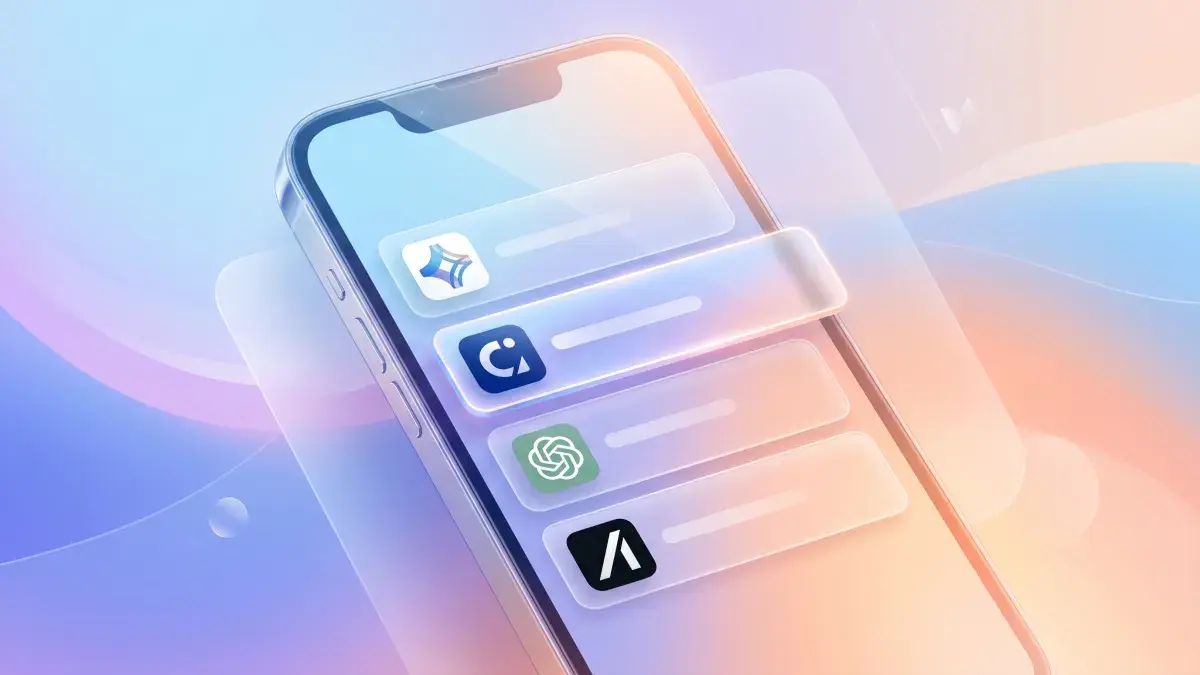
The mechanism is a new system called Extensions. In Apple's words, extensions "allow you to access generative AI capabilities from installed apps on demand, through Apple Intelligence features such as Siri, Writing Tools, Image Playground and more." In plain English: install the Claude or Gemini app, go to Settings, and set it as your preferred model. From then on, when an Apple Intelligence feature needs a large language model, it routes to your pick instead of the default.
The model picker shows up across the system — Siri, Writing Tools, Image Playground, Shortcuts, and the new App Intents surface that can turn any installed app into a Siri-callable endpoint. Apple even lets third-party assistants use a distinct voice, so you can tell at a glance whether Siri or, say, Gemini is the one answering. This is a clean break from iOS 26, where the ChatGPT integration was the only game in town.
Which AI models can you choose?
At launch, the headline options are Claude (Anthropic), Gemini (Google), ChatGPT (OpenAI), and Grok (xAI). Apple is reportedly rolling out Claude and Gemini as the first two third-party partners alongside the existing ChatGPT integration, with the Extensions marketplace designed to let others plug in over time. The developer beta landed June 8, 2026; a public beta is expected in July, with the full public release of iOS 27, iPadOS 27, and macOS 27 arriving in fall 2026.
Notably, the news lands right as the AI labs are jockeying for exactly this kind of reach. It comes the same month that Anthropic and OpenAI both filed to go public, and not long after Apple was reported to be building a Gemini-powered version of Siri. For companies trying to justify enormous valuations, default placement on a billion iPhones is about as valuable as distribution gets.
Why this is a big deal
Three reasons. First, distribution. Being one tap away inside Siri and Writing Tools puts Claude, Gemini, and Grok in front of users who would never download a standalone chatbot app. Apple is effectively becoming a neutral router for the AI industry — the way a browser lets you change your default search engine. Second, competition. By ending the single-provider model, Apple forces the labs to compete on quality and price for that default slot, which is good for users and brutal for whichever model gets unset. Third, strategy. Apple's own on-device models still handle the private, low-latency work; the third-party extensions handle the heavy generative requests. That mirrors the on-device-first approach hinted at in the pre-WWDC on-device AI leaks — Apple keeps the privacy story, while outsourcing the frontier-scale reasoning to whoever you choose.
It also reframes the entire assistant war. For a year the question was "which model is smartest" — a race that produced leaps like the GPT-5.5 leak and Anthropic's agentic Claude push. iOS 27 quietly changes the question to "which model do you want in your pocket" — and lets you switch any time you like.
The catch
Choice is not the same as parity. The exact capabilities each extension can tap — and how deeply it can hook into Siri versus Apple's own models — will depend on what Apple's Extensions API exposes, and on the deals behind each integration. There are also open questions about privacy: routing a request to Gemini or Claude means handing data to a third party, and how Apple discloses and gates that will matter. But the headline is unambiguous: for the first time, the AI behind your iPhone is a setting you control, not a partnership you're stuck with.
Origin
At its WWDC 2026 keynote on June 8, 2026, Apple announced an 'Extensions' framework in iOS 27 / iPadOS 27 / macOS 27 that lets users set a third-party AI model — Claude (Anthropic), Gemini (Google), ChatGPT (OpenAI), or Grok (xAI) — as the provider behind Apple Intelligence features including Siri, Writing Tools, and Image Playground. This ends Apple's prior single-provider (ChatGPT-only) arrangement from iOS 26. Developer beta shipped June 8, 2026; public beta expected July; public release fall 2026. Reported by MacRumors, AI Weekly, Tom's Guide, and TheNextWeb.
Timeline
Why Is This Trending Now?
It's trending because it upends how Apple Intelligence works: instead of a single ChatGPT integration, iOS 27 lets a billion-plus Apple users pick which AI model — Claude, Gemini, ChatGPT, or Grok — powers Siri, Writing Tools, and Image Playground. The timing magnifies it: the announcement came the same month Anthropic and OpenAI both filed to go public and amid reports of a Gemini-powered Siri, turning a settings toggle into a high-stakes distribution prize the major AI labs are fighting over.
Frequently Asked Questions
Sources
- MacRumors – iOS 27 Will Let You Pick Claude or Gemini Instead of ChatGPT for Apple Intelligence
- MacRumors – What to Expect From WWDC 2026: Gemini-Powered Siri, iOS 27, macOS 27 and More
- Tom's Guide – Apple WWDC 2026 recap: Siri AI, iOS 27, Apple Intelligence
- TheNextWeb – Apple finally ships its AI do-over: Siri AI, a standalone app, and a three-tier privacy stack
- AI Weekly – Apple iOS 27 Extensions Opens Third-Party AI Marketplace at WWDC 2026