What is The DIY Air Conditioner Trend Returns Every May (And Why The Physics Doesn't Work)?
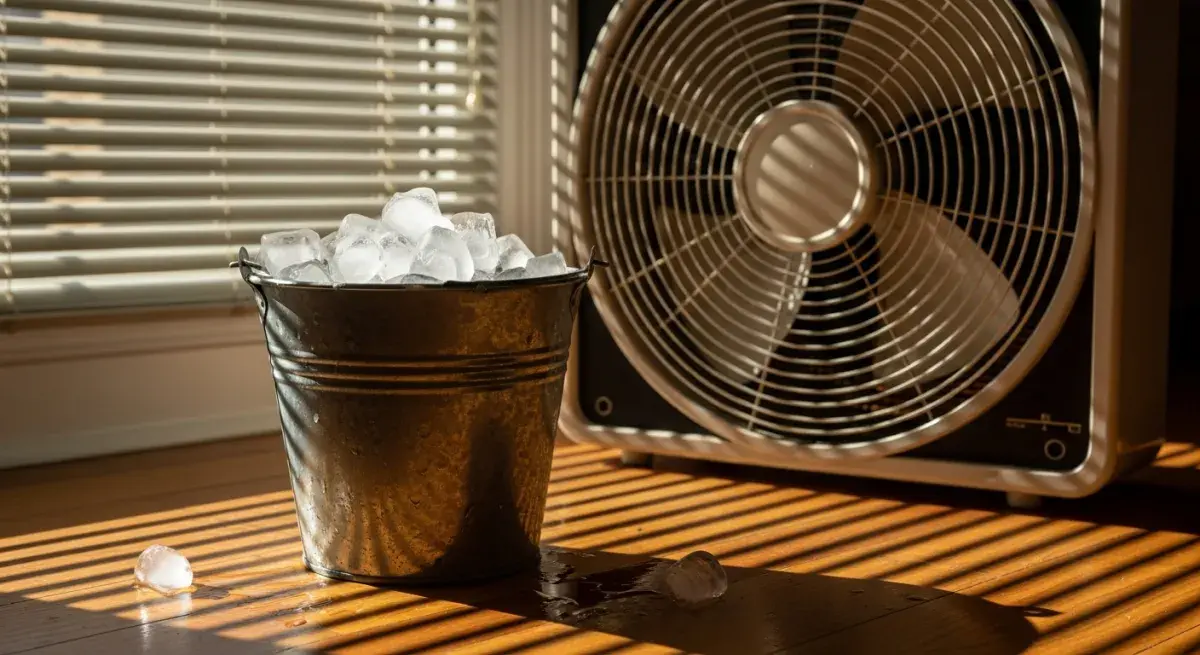
Type 'DIY air conditioner' into TikTok any time between mid-April and early June and you will see the same clip you saw last May, the May before, and the May before that. A five-gallon bucket. A bag of ice cubes. A white box fan duct-taped to the lid, blades pointing down into the bucket. A hole or two cut into the side. The creator stands in front of it with their hand out, looking pleased. The caption is some version of $20 AC hack — landlord can't say anything!!! The comments are split: half saying it changed their life, half saying they tried it and it stopped working after twenty minutes.
Both halves of the comment section are right. The bucket-fan setup does cool air locally — for a while. Then it gives up, and you end up with a humid room that is now slightly warmer than when you started. The reason this happens is straightforward physics. The reason the clip goes viral every May regardless is straightforward TikTok mechanics. Both are worth understanding because the same pattern is going to repeat in 2027, 2028, and so on for as long as the platform exists.
Why the clip goes viral every spring without fail
The DIY-AC clip is one of the cleanest examples of a recurring viral mechanic. The original bucket-fan video — or one of its earliest mainstream-coverage moments — was a Daily Mail piece in 2015 about a YouTube tutorial for the same setup. That clip has been re-uploaded with new audio, new creators, new captions, and slightly different bucket aesthetics every year since. Realtor.com ran a piece on the 2026 version in late April, which is part of why this is now the second-week-of-spring discourse cycle.
The mechanic is: TikTok's algorithm is heavily seasonal for utility content. The first time the temperature crosses 80°F in any given US metro, search-volume for 'how to cool a room without AC,' 'cheap AC hack,' and 'window AC vs portable' all spike together. The algorithm responds by promoting any 'summer hack' video that has accumulated even mild engagement in past cycles. The bucket-fan clip is the most-engaged piece of summer-hack content ever produced, partly because it is genuinely visually satisfying (the ice, the spinning fan, the cold-mist illusion) and partly because the comment section fights about whether it works, which the algorithm reads as engagement, which boosts the next round.
So every spring the same clip gets resurfaced, gets re-stitched, gets dueted, gets remade by hundreds of creators trying to ride the seasonal wave. It is the closest thing TikTok has to a Mother's Day cookie recipe — predictable, evergreen, perennially profitable for whoever happens to make this year's version. The video format is locked in; only the production values change.
The physics: why it feels like it works at first
Air blown across ice does cool down. That part is real. A box fan moves ambient room air across the surface of the ice, the ice absorbs heat from the air to melt, and the air on the downstream side comes out measurably cooler than the air on the upstream side. If you stand directly in the airstream right after setting it up, you will feel cool air. Phone-attached infrared thermometers have measured the difference at 3-7°F at the immediate fan exit, and YouTube physics channels including Tom Scott and Practical Engineering have run the experiment on camera. The local cooling effect is not the part that fails.
The part that fails is the room-cooling effect. To understand why, you have to think about what air conditioners actually do. A real AC unit is not a cold-air generator — it is a heat pump. It absorbs heat from the air inside the room and transfers that heat to the air outside the room (which is why the back of a window AC blows hot air outside, and why a portable AC needs an exhaust hose). The room gets cooler because heat is being removed from it.
A bucket-and-fan setup does not remove any heat from the room. The heat the air gives up to the ice gets stored in the now-melted ice water. That ice water is sitting in your bedroom. As soon as the ice fully melts, all the heat the air shed into the ice during melting is now still in the room, just in liquid form. There is no way out for it. The thermodynamic accounting is closed: you put cold ice in, you got cool air briefly, you ended up with the same total heat in the room minus the small amount of energy your fan motor added (which becomes heat) and minus the energy lost through evaporation if the bucket is open — but plus the latent heat of fusion now stored as warm meltwater.
Why it gets worse, not just neutral
If the math just balanced, the bucket trick would feel neutral after the ice melted. It does not feel neutral. It feels worse. Here is why.
Open ice in a fan stream evaporates and condenses moisture into the room air at high rates. By the time the bucket is half-melted, the relative humidity in a typical 12x12 bedroom has gone up by 10-25 percentage points. Humidity is the thing that makes hot air feel hot — the human body cools itself by sweating, and sweating only works when sweat can evaporate, and sweat only evaporates efficiently when the surrounding air is dry. Raise the room humidity from 40 percent to 65 percent and the perceived temperature jumps by several degrees even if the actual air temperature is unchanged.
So the bucket trick: cools air locally for 20-40 minutes; stores all extracted heat as room-temperature meltwater that cannot escape; raises room humidity substantially; ends with the room feeling worse than when you started. The disappointment is structural.
There are versions of the trick that try to fix the humidity problem — sealed bucket with copper coils, salt-ice slurries, frozen water bottles instead of cubes — and they help marginally with humidity but do nothing about the closed-system problem. The heat still has nowhere to go.
What actually moves heat out of a room
The cheapest device that actually moves heat out of a room is a window air conditioner. Entry-level 5,000-6,000 BTU units run $130-180 at Home Depot, Lowe's, or Costco; mid-tier 8,000-10,000 BTU units run $250-350. They consume about 400-1,200 watts depending on the BTU rating. A 5,000 BTU window unit can lower the temperature of a 150 square foot bedroom by 10-15°F in roughly 30 minutes and hold it indefinitely. Per watt of electricity consumed, a window unit moves something like 50-100 times more heat out of the room than a bucket-fan setup, because the bucket fan moves zero heat out of the room.
Portable AC units (the standalone kind with one exhaust hose) cost more, $300-600, and are roughly 40-60 percent less efficient than window units because the single-hose design pulls room air across the condenser and exhausts it outside, creating negative pressure that pulls hot outside air back in through every gap in the room. They are still vastly more effective than a bucket. Dual-hose portables are better but cost $500-800.
For the budget the bucket-fan trend implies (under $50), the actually-useful setups are: (1) a powerful box fan in the window pointed outward to push hot air out, paired with another fan pointed inward in a cooler part of the house — this creates a cross-breeze that exchanges room air with outside air, useful in early morning and late evening when outside is cooler; (2) closing blinds and curtains during peak sun to reduce solar heat gain; (3) running ceiling fans counter-clockwise; (4) showering and going to sleep with damp hair — wet skin in moving air cools efficiently. None of these are as cinematic as a bucket of ice, which is why none of them go viral.
The meta-trend: why TikTok prefers DIY hacks over actual products
The DIY-AC trend is a clean instance of a broader algorithmic preference: short-form video systematically rewards content that looks empowering and scrappy over content that actually solves the problem. A 30-second video saying 'just buy a $130 window AC at Home Depot' will generate one-tenth the engagement of a 30-second video about putting ice in a bucket. The reasons are aesthetic and structural. Buying the right tool is not visually interesting. It does not feel like beating the system. It does not produce the comment-section debate that drives algorithmic distribution. It does not let the creator stand in for the viewer's resentment toward landlords, utility bills, or 'big AC.'
Recommend-the-real-tool content also does not get sponsorship. DIY-hack content does — affiliate codes for the bucket, the fan, the duct tape, and adjacent 'cooling' products are stacked into the description of every viral version. The economic incentive points the same direction as the algorithmic one. Real solutions are commercially less interesting than fake solutions for short-form video creators in particular, because their entire business model depends on appearing to give the audience an underdog edge.
This is not unique to the AC clip. The same pattern recurs across de-influencing content (which is itself a kind of meta-influencing), DIY personal finance hacks, viral cleaning tutorials, and most home-improvement content. The common thread: the framing of the video is more important than the outcome of the video. The bucket clip is a near-perfect specimen because the failure is delayed by 20-40 minutes, which is well after the average viewer has scrolled away.
Safety: the part nobody mentions
There are real risks. Box fans pulled across open water are an electrical hazard — water can splash into the motor, ice melt can drip onto the cord, and a fan plugged into an outdoor or garage outlet that is not GFCI-protected creates a meaningful shock risk. A 2017 Consumer Product Safety Commission incident database review by the National Electrical Safety Foundation found multiple house fires linked to fan motors that had been modified for cooling tricks. The risk is small but nonzero and grows substantially when the bucket is left running unattended overnight.
The condensation problem creates a second risk. Bucket condensation pools onto floors and into wood. Rugs and underlayment that get repeatedly damp grow mold. A reader running this setup three nights a week for two summer months in a carpeted room will produce a measurable mold problem by August in any humid metro. Window AC units do produce condensation too, but they are designed to drain it outside the building.
What to do this May instead
If you are renting and cannot install a window unit, ask first — many landlords allow window ACs with brackets, and many local Buy Nothing groups have free or $20 used units sitting in basements. If you genuinely cannot install one, the order of operations is: blackout curtains during peak sun (huge effect, $30-60), cross-breeze fan setup in early mornings and late evenings, ceiling fans on summer rotation, and a single small portable fan trained directly on the bed at night. None of these are bucket-cinematic, but the room will be 5-10°F cooler than the bucket setup will deliver after the first 30 minutes.
And when you see the bucket clip in your feed in early May 2027 — and you will — recognize the pattern. The platform is going to recommend the same illusion to a fresh cohort of warm-weather first-timers every year for as long as the platform exists. The trick will keep working for the algorithm. It will keep not working for the room.
What actually works under $200
If the bucket-fan setup is off the table because, well, the physics, here are the products our editors actually use to cool a small or medium room. None are bucket-cinematic; all of them move heat the way a cooling device is supposed to.
- Honeywell QuietSet Whole Room Tower Fan (HYF290B) — Eight speeds from whisper-quiet to power-cool, 40" tall, oscillating. The fan you actually want in the bedroom for the cross-breeze setup the article describes. Roughly $90.
- Lasko 36" Oscillating Tower Fan (Model 2511) — The budget benchmark. Three speeds, remote, programmable timer. Pair two of these (one window-out, one room-in) for the early-morning / late-evening cross-breeze. Roughly $50-60.
- Hessaire MC37M Portable Evaporative Cooler (3,100 CFM) — A real swamp cooler — works in dry climates (relative humidity under ~50%) where evaporation actually drops air temperature. Wildly more effective than the bucket variant in the right conditions. Roughly $200.
As an Amazon Associate, we earn from qualifying purchases. Prices shown are typical — check Amazon for current pricing.
For more on how viral mechanics shape what we believe about the world, see our explainers on de-influencing, AI slop, and main character syndrome.
Origin
The earliest mainstream coverage of the bucket-and-fan DIY AC setup traces to a Daily Mail article in July 2015 about a viral YouTube tutorial that had circulated on Reddit's r/lifehacks. That tutorial itself drew on much older 'swamp cooler' designs from the 1990s home-improvement web. The clip has been re-uploaded with new audio, new creators, and small visual variations every spring since 2015 — first on Facebook and Pinterest, later on YouTube Shorts and TikTok. The 2026 cycle is the eleventh consecutive year the format has gone broadly viral on at least one major platform. Realtor.com ran an explainer on the current version in late April 2026, which is one of the signals that this year's cycle has hit mainstream-news pickup.
Timeline
Why Is This Trending Now?
The DIY-AC clip recurs every May because of three converging mechanics. First, seasonal search demand for cooling content spikes the first time temperatures cross 80°F in major US metros, which happens in late April or early May for most of the country. Second, the TikTok algorithm preferentially boosts utility content that has accumulated engagement in past cycles, and the bucket-fan setup is the most engagement-rich piece of summer-hack content ever produced — comment sections argue about whether it works, which the algorithm reads as engagement and rewards. Third, mainstream news pickup (Realtor.com in 2026) signals to lifestyle editors at adjacent outlets to publish their own versions, which produces a secondary wave of search demand and social distribution. The 2026 cycle began in mid-April and will sustain through Mother's Day weekend.
Frequently Asked Questions
Sources
- Daily Mail — How to make your own air-conditioner for under $25 (2015)
- Realtor.com — Does the Viral Bucket-and-Fan Air Conditioner Actually Work?
- Practical Engineering — Why DIY Air Conditioners Don't Work (YouTube, 2024)
- Consumer Product Safety Commission — Incident Database for Modified Box Fans
- Department of Energy — Room Air Conditioner Efficiency Guide