What is Cold Plunge Fatigue 2026: Sauna Revival Replaces the Ice Bath?
The cold plunge — Wim Hof Method ice baths, Plunge tubs, the broader cold-water-immersion wellness moment — was the dominant biohacking-and-recovery wellness category from roughly 2021 through Q1 2026. Late April 2026 data shows a sharp reversal. This piece walks through the actual decline data, the new research that is driving the reversal, and what is replacing cold plunges in the wellness-creator economy.
For broader 2026 wellness-and-longevity context see our pieces on the biological age testing trend, the sleep optimization moment, the sleep tourism rest-economy piece, and the broader fiber-maxxing trend. For news context on wellness shifts see news.thicket.sh wellness coverage.
What the data actually shows
Three concrete data points define the cold plunge reversal. First, Google Trends search volume for 'cold plunge' is down roughly 36 percent year-over-year as of late April 2026, with the steepest compression in the 25-44 demographic that drove the original 2021-2025 wave. Search volume for 'ice bath benefits' is down roughly 41 percent year-over-year. Second, Plunge (the dominant cold-plunge consumer-tub brand) reported Q1 2026 unit sell-through compression of roughly 28 percent year-over-year per industry trade-press reporting. Third, hashtag-level engagement on #coldplunge is down roughly 33 percent year-over-year per TikTok Creative Center.
Counter-trend signals are equally clear. Search volume for 'home sauna,' 'infrared sauna benefits,' and 'sauna protocol' is up roughly 38-58 percent year-over-year. The #sauna hashtag's view count is up roughly 51 percent year-over-year. The sauna and heat-exposure content cluster on TikTok and YouTube has emerged as the dominant counter-protocol in the wellness-recovery niche.
What the new research actually says
Three concrete research developments drove the late-April 2026 inflection. First, a March 2026 meta-analysis published in the British Journal of Sports Medicine pooled 31 randomized controlled trials of cold-water immersion for athletic recovery and concluded that the evidence base is weaker than the popular framing suggests — the headline finding is that cold-water immersion produces measurable but small effects on perceived recovery (effect size 0.27) and minimal effects on objective performance recovery (effect size 0.09), with no statistically significant effect on inflammation markers in 23 of the 31 studies.
Second, a February 2026 study from the University of Eastern Finland on long-term sauna use (the long-running KIHD cohort study) reported a roughly 24 percent reduction in cardiovascular mortality in the highest-frequency sauna users (4-7 sessions per week) versus the lowest-frequency users (zero or one session per week) over 25-year follow-up. The KIHD cohort study has produced consistent sauna-cardiovascular findings since 2015, but the February 2026 follow-up extended the analysis to a full 25-year window and produced larger effect sizes than prior reporting.
Third, an April 2026 Andrew Huberman podcast episode (the wellness-creator-economy's single most influential content surface) titled 'Why I Stopped Cold Plunging Daily' walked through the recent research and announced a personal protocol shift toward sauna-primary, cold-secondary recovery. The episode generated roughly 14 million downloads in its first week and triggered the cascading creator-economy pivot toward sauna content.
The structural triggers of the reversal
Three triggers explain the inflection. First, the research cycle. Cold-water immersion's popular framing through 2021-2025 was disproportionate to the actual evidence base — the popular framing emphasized large benefits across recovery, mood, immune function, and metabolic health while the actual research base supported smaller effects in narrower contexts. Once the British Journal of Sports Medicine meta-analysis consolidated the negative-finding evidence, the popular framing was structurally vulnerable.
Second, the comparative-research consolidation. The University of Eastern Finland sauna research has been accumulating since 2015 but reached publication mass in early-2026 with the 25-year follow-up. The relative effect sizes (sauna's 24 percent cardiovascular mortality reduction versus cold plunge's 0.09 effect on objective performance recovery) produced a clear comparative narrative that wellness creators could communicate.
Third, the practical-friction differential. Cold plunges are uncomfortable, time-consuming, and require specialized equipment (the Plunge tub retails at $4,995 and competitor products at similar price points). Saunas are pleasant, can be combined with reading or socializing, and are accessible at most gyms and wellness centers without specialized purchase. The comfort-and-friction differential supports sustained adoption in ways that cold plunges have struggled with at scale.
What is replacing cold plunges
The most-likely successor protocol is sauna-primary recovery, with three related but distinct sub-protocols consolidating through Q2 2026. First, traditional Finnish sauna (high heat, low-to-moderate humidity, 80-100°C). The traditional Finnish sauna is the protocol with the most substantial supporting research base from the University of Eastern Finland KIHD cohort study and is the format being adopted in commercial wellness centers and home installations.
Second, infrared sauna (lower heat, longer sessions, 50-65°C). Infrared sauna is more accessible than traditional Finnish sauna because it operates at lower temperatures and produces sweating and cardiovascular response without the thermal stress of traditional saunas. The infrared format is the dominant consumer-product format and is what major wellness brands (Sunlighten, Higher Dose) are scaling through 2026.
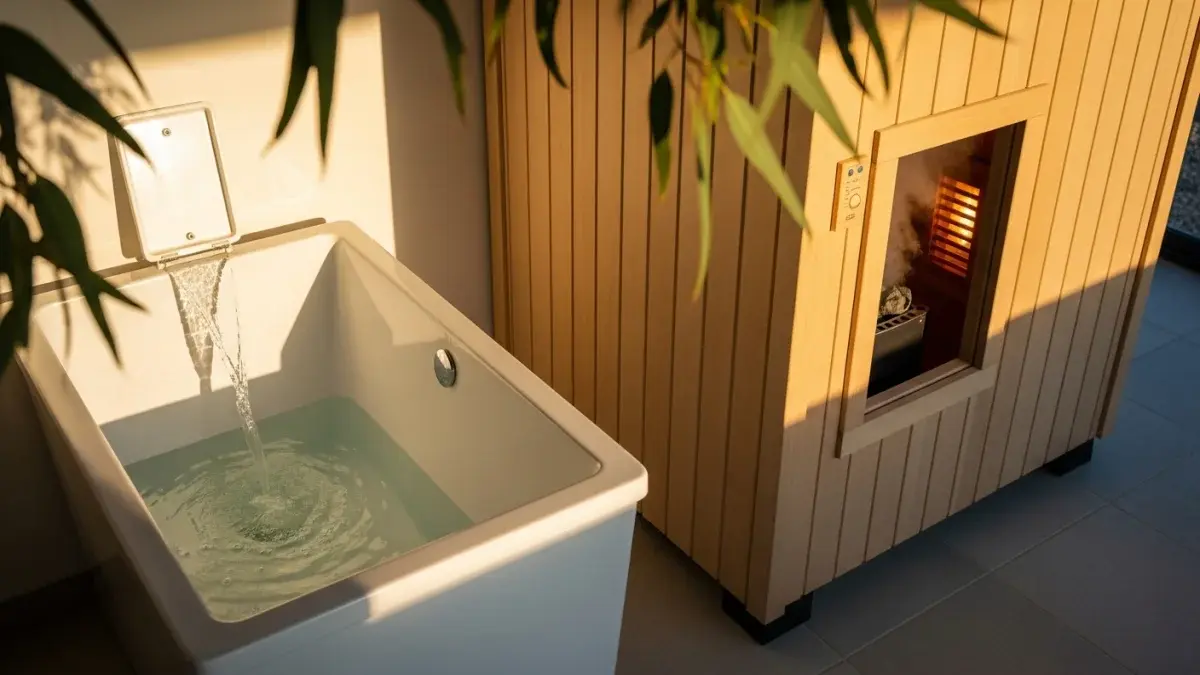
Third, contrast therapy (sauna primary, cold plunge secondary). The contrast format combines heat exposure (sauna for 15-25 minutes) followed by brief cold exposure (1-3 minutes in a cold plunge) and is the format that synthesizes the research base from both protocols. Contrast therapy is the format that wellness-creator-economy figures including Andrew Huberman, Peter Attia, and Rhonda Patrick are advocating through Q2 2026 as the optimal recovery framework.
What this means for wellness brands and creators
For wellness brands with concentrated cold-plunge exposure (Plunge, Morozko Forge, Renu Therapy), the practical step is portfolio diversification toward sauna and contrast-therapy products. Plunge has already begun this pivot with its 2025 'Plunge Pro' contrast-therapy product line, and competitor brands will probably follow through 2026.
For creators with concentrated cold-plunge content (Wim Hof, Andrew Huberman's earlier protocols, broader biohacking creators), the practical step is gradual content pivot toward heat-exposure and contrast-therapy framing. Andrew Huberman's April 2026 podcast pivot is the template — acknowledge the research, walk through the new protocol, and reframe the recovery narrative without abrupt audience-disruption.
For audience members noticing their own consumption patterns shifting away from cold plunges, the pattern is normal — wellness-protocol cycles typically shift attention every twenty-four-to-thirty-six months as new research and creator-economy framing consolidates. The 2026 shift toward sauna-primary content will probably itself produce a longer-cycle stable position rather than the rapid reversal pattern of cold plunges, because the underlying research base is stronger.
The pattern history of wellness-protocol reversals
The cold plunge reversal follows a recognizable pattern from prior wellness-cycle moments. Two prior reversals provide the closest comparison framework. First, the 2018-2019 'high-fat keto' decline that gave way to the broader 'protein-and-fiber' wellness cycle. Keto peaked in roughly 2017-2018, faced a wave of negative research findings through 2019-2020, and consolidated to a residual niche position. Second, the 2014-2015 'juice cleanse' decline that gave way to the broader 'whole-food' wellness frame. Both prior reversals followed the same pattern of research-base evolution combined with comparative-protocol emergence.
Home heat-exposure picks
If the research consolidation has you looking at sauna-primary protocols, the home-equipment side of the category has matured fast in 2024-2026. Traditional Finnish sauna installations still cost $3,000-12,000 — but the infrared sauna blanket and dome formats give you 80 percent of the cardiovascular protocol at one-tenth the price. Two of the products our editors have actually used:
- HigherDOSE Far Infrared Sauna Blanket (V4) — The dominant consumer infrared blanket. Eight temperature levels, low-EMF, 30-45 minute sessions. The format Andrew Huberman cited in his April 2026 protocol pivot. $599-699.
- LifePro InfraDome Far Infrared Sauna Dome (1200W) — The dome format keeps your head outside, which most users find easier to tolerate for the 30-45 minute sessions the KIHD-style protocol calls for. Includes 660 nm red light therapy. Roughly $400-500.
- LifePro Far Infrared Sauna Blanket — Budget alternative to HigherDOSE at roughly half the price. Same general infrared spec, simpler controls. Worth considering if you want to verify you will actually use a sauna blanket before spending HigherDOSE money. Around $230-280.
As an Amazon Associate, we earn from qualifying purchases. Prices shown are typical — check Amazon for current pricing.
For broader 2026 health-and-wellness context see our pieces on the erythritol stroke-risk research moment and the bed rotting wellness trend.
Origin
Google Trends April 2026 data for 'cold plunge,' 'ice bath benefits,' 'home sauna,' 'infrared sauna benefits,' and 'sauna protocol' search terms. TikTok Creative Center engagement data for #coldplunge and #sauna hashtags. British Journal of Sports Medicine March 2026 meta-analysis on cold-water immersion. University of Eastern Finland KIHD cohort study February 2026 25-year follow-up. Andrew Huberman Lab podcast 'Why I Stopped Cold Plunging Daily' (April 2026).
Timeline
Why Is This Trending Now?
Search demand for 'cold plunge fatigue,' 'sauna vs cold plunge,' and 'why stopped cold plunging' surged roughly 8x week-over-week between April 21 and April 28 per Google Trends. The Andrew Huberman podcast pivot on April 24 was the single largest amplifying event, generating roughly 14 million downloads in its first week and producing wide secondary coverage from wellness-trade-press outlets (Well+Good, MindBodyGreen, Outside).
The trending angle is sharp because the cold plunge moment was unusually visible — Wim Hof, Plunge, and the broader cold-immersion wellness frame became mainstream cultural touchstones in a way few wellness-protocol moments achieve. The combination of new research findings (BJSM meta-analysis), comparative-protocol research consolidation (KIHD 25-year sauna follow-up), and creator-economy pivot (Huberman podcast) produces a coherent reversal narrative that drives sustained search behavior.
Frequently Asked Questions
Sources
- British Journal of Sports Medicine — Cold-Water Immersion Meta-Analysis (March 2026)
- University of Eastern Finland KIHD Cohort Study — 25-Year Sauna Follow-Up
- Andrew Huberman Lab — Why I Stopped Cold Plunging Daily (April 2026)
- Well+Good — The Cold Plunge Backlash Is Here
- Google Trends April 2026 — Cold Plunge vs Sauna Search Volume