What is Sleep Tourism Is Now A $100B Hotel Category — Why The 'Rest Economy' Took Over The Hospitality Industry?
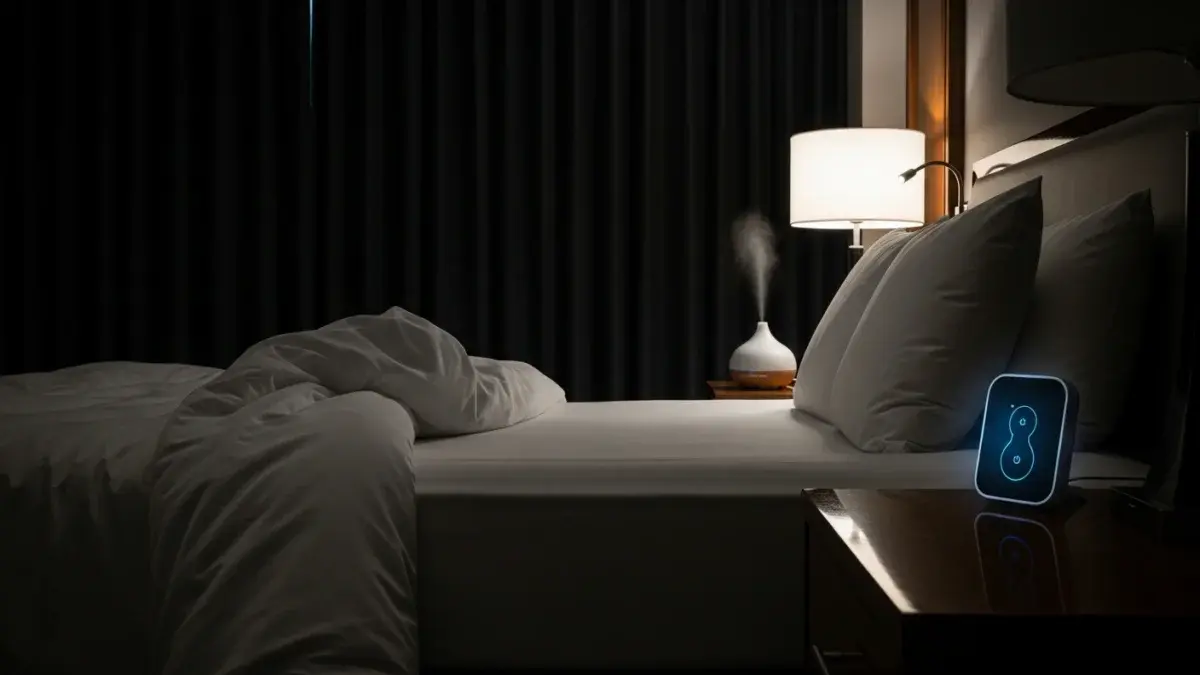
The first time you check into a Park Hyatt 'Restorative Hospitality' room you notice the absences before the additions. There is no minibar. There are no LEDs visible in the room — even the alarm clock has been replaced with an analog one, and the TV's standby light is masked. The HVAC has been recalibrated to a wider temperature range and adjusts overnight to track typical sleep-cycle preferences. The mattress is one of three options chosen during booking. The pillows are a menu. The curtains are blackout-rated to a standard the hotel publishes. There is a tea-brewing setup with non-caffeinated options. There is a small device on the nightstand that is not a phone and does not have a screen, but plays white noise, brown noise, or ocean sounds depending on what you set it to. And there is, in the welcome packet, a 30-minute appointment scheduled with a 'sleep coach' the next morning if you want it.
Rooms like this rent for between $800 and $1,800 per night depending on city and property. They book out, sometimes months in advance. The sleep-tourism category — premium hotel programming explicitly built around sleep quality rather than around the standard luxury-hotel attention to dining, spa, and view — has been the fastest-growing premium segment in hospitality since 2024, and Skift's 2026 hospitality outlook called it the year's defining trend.
How a luxury subcategory became an industry strategy
Sleep-focused hotel programming existed in small niches well before 2020 — the Equinox Hotel in Hudson Yards opened in 2019 with sleep coaching as a core amenity, and several wellness-focused resorts (Six Senses, Lefay, COMO Shambhala) have offered sleep retreats for over a decade. What changed between 2020 and 2026 is that mainstream luxury hotel groups recognized sleep tourism as a programming strategy with significant pricing power, and built it into their core property portfolios rather than treating it as a wellness-resort niche.
The Park Hyatt rollout in February 2026 was the bellwether. Hyatt announced 'Restorative Hospitality' as a brand-wide initiative across 12 Park Hyatt properties — Tokyo, New York, Vienna, Sydney, Buenos Aires, and others — with each property meeting a defined sleep-programming standard: blackout curtains rated to a published standard, mattress and pillow menus, programmable HVAC, ambient-noise systems, and access to in-house or partnered sleep coaches. Rosewood, Mandarin Oriental, and Aman followed within weeks with their own programs. By Q2 2026 every major luxury hotel group had a public sleep-tourism strategy.
The reason this happened in 2026 specifically is the maturation of the consumer-side data layer. Wearable sleep trackers — Oura Ring, Whoop, Apple Watch, Fitbit — went from niche to mainstream between 2019 and 2024. By 2026 the median upscale-leisure traveler can quote their average sleep latency, REM percentage, and resting heart rate from memory, and has opinions about which environmental factors degrade those numbers. Hotels that explicitly target those metrics — and that can show traveler-tracker data improving on-property — have a quantifiable product story that competing properties without sleep programming cannot match.
What is actually different in a sleep-tourism property
The serious sleep-tourism programs share six elements. First, controlled darkness — blackout curtains rated to a measurable standard (typically 99-99.9 percent light blockage), with masking on every LED in the room. Second, controlled sound — either acoustic engineering for low ambient noise, or active ambient-noise systems (white noise, pink noise, brown noise, ocean) that can be set per-guest. Third, controlled temperature — programmable HVAC with a wider range than standard hotels, and bedding systems (cooling sheets, weighted blankets, or both) selected per guest. Fourth, mattress and pillow choice — booking includes a selection of mattress firmness and pillow type, with the hotel staging the selected option in the room before arrival. Fifth, in-room circadian programming — typically a tea or hydration setup, dim lighting only after a set hour, and an analog (not digital) clock. Sixth, optional sleep coaching — a 30-minute consultation with a trained coach who reviews the guest's wearable data and adjusts the room programming accordingly.
The expensive part of all of this is not the bedding or the noise machine — it's the building. Retrofitting a hotel for genuine sleep programming requires acoustic upgrades to walls and HVAC, blackout systems that integrate with the curtain hardware, and HVAC zoning that can run cooler at night without affecting daytime comfort or other rooms. The Park Hyatt rollout was specifically a 12-property, capital-intensive renovation, not a software update. New properties (Six Senses Bhutan, Equinox Hotels) are designed for sleep programming from initial build, which is cheaper and produces better acoustic outcomes than retrofitting.
The data side: do these rooms actually improve sleep?
The early evidence is yes, modestly, with significant individual variation. Equinox Hotels has published wearable-data studies (with consenting guests using Whoop devices) showing average sleep-quality-score improvements of 8-15 percent during stays compared to guests' rolling 30-day baselines. Other properties have published similar studies with similar magnitudes. The interpretation: sleep-programmed rooms are not transformative on their own, but they reliably reduce the sleep degradation that travel ordinarily causes. A traveler whose sleep typically degrades 15-25 percent during a hotel stay (because of unfamiliar bedding, ambient light, ambient noise, and HVAC defaults) will instead see 0-5 percent degradation in a sleep-tourism property, and sometimes a modest improvement above home baseline.
The honest caveat: the sleep-tourism premium ($300-1,000+ per night above non-sleep luxury rooms in the same city) is a steep price for a few percent of sleep-quality improvement, and most of the value the rooms provide is psychological — guests like having sleep treated as the central product of the hotel, not as a side effect. The cost-benefit analysis works for high-frequency business travelers and for leisure travelers who specifically come to a property to recover from sleep debt. It works less well for the median traveler taking a 3-night city stay.
The mass-market trickle-down
The interesting question for 2026 and beyond is whether sleep-tourism programming trickles down from luxury to mid-market hotels. The trickle-down has begun. Marriott's Westin brand, which has positioned around 'Heavenly Bed' since 1999, expanded its sleep programming in 2025 to include blackout-curtain upgrades, melatonin-friendly lighting, and partnerships with wearable brands at properties globally. Hilton, Hyatt's Hyatt Place mid-market line, and Accor have all rolled out lighter-touch sleep programs at price points well below luxury. The mid-market version is roughly 60-70 percent of the luxury programming for 30-40 percent of the premium, which is a value proposition that scales much better than the high-end version.
By 2027-2028, basic sleep programming — good blackout curtains, mattress choice, ambient noise — will likely be table-stakes at any hotel above $200 per night. The bleeding-edge programming will continue to be a luxury differentiator. The category that is genuinely at risk is mid-market hotels that have not invested in sleep at all; once a critical mass of comparable properties offer it, the no-sleep-programming hotels will lose the segment of travelers who care about it, which is increasingly large.
For more on how rest, attention, and consumption are being rethought in 2026, see our pieces on sleep optimization, silent walking, and biological age testing.
Origin
Sleep-focused hotel programming has roots stretching back at least to the 1999 launch of Westin's 'Heavenly Bed,' which was the first major branded mass-market hotel investment in mattress and bedding quality as a core product attribute. Wellness-focused luxury resorts (Six Senses, COMO Shambhala, Lefay) have offered dedicated sleep retreats since at least the early 2010s. The Equinox Hotel in Hudson Yards, opened in 2019, is widely credited as the first major US urban property built around sleep coaching as core programming. The category's transition from niche-luxury to mainstream-luxury industry strategy traces to the Park Hyatt 'Restorative Hospitality' rollout in February 2026, which prompted Rosewood, Mandarin Oriental, Aman, and other major luxury groups to announce comparable programs within weeks. Skift's 2026 hospitality outlook designated sleep tourism the year's fastest-growing premium category.
Timeline
Why Is This Trending Now?
Sleep tourism crossed two thresholds in spring 2026 that pushed it from luxury-hotel niche into mainstream travel coverage. First, the major hotel groups have publicly disclosed sleep-focused programming as core strategy: Hyatt's 'Restorative Hospitality' initiative launched in February 2026 across 12 Park Hyatt properties, Six Senses opened a dedicated sleep-program property in Bhutan, and Rosewood's spring 2026 lineup includes sleep retreats at six properties globally. Second, Skift's 2026 hospitality outlook explicitly named sleep tourism the fastest-growing premium segment of the year, with industry estimates putting global market size in the high tens of billions and on track for $100B by 2027.
The trend is hitting now because the underlying market is maturing. Sleep optimization has been a growing consumer trend since at least 2020 — the wearable-data revolution (Oura, Whoop, Apple Watch sleep tracking) created a generation of consumers who measure their own sleep daily and have preferences about it. Hotels that figured out how to translate that into a premium product offering have priced their way into bookings that compete with the highest-end leisure travel categories. Spring 2026 is the moment this stopped being marketing language and became measurable industry transformation.