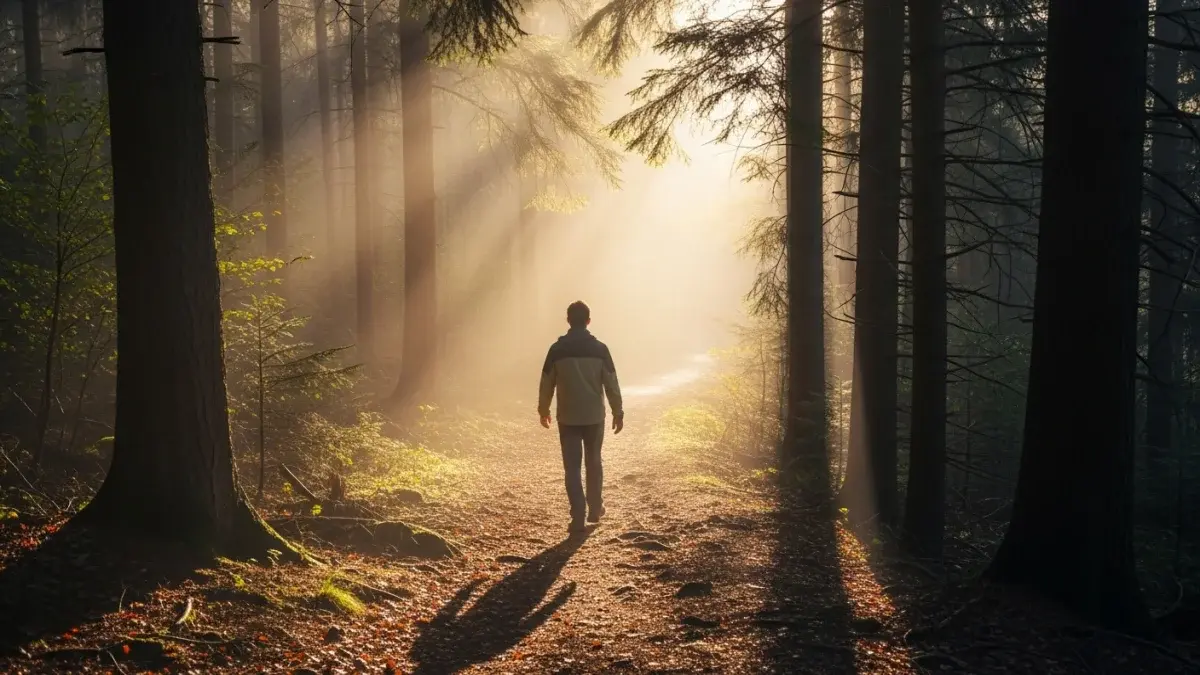
What is Silent Walking Is The Wellness Trend That Refused To Die — Why It's Bigger In 2026 Than When It Started?
Silent walking went viral in summer 2023 from a TikTok by creator Mady Maio in which she described how walks without her phone, headphones, or any audio input had transformed her mental state. The video was met with widespread mockery — the dominant response was variants of 'congratulations, you reinvented walking,' and screenshots of the post circulated for weeks as evidence that Gen Z was incapable of recognizing how millennia of humans had functioned. The mockery was loud enough that the original trend appeared to die within a few months.
It did not die. It came back, quietly, through completely different channels. Andrew Huberman discussed silent walking in his October 2024 episode on default-mode-network restoration. Cal Newport recommended it in his 2025 book on attention. The American Psychological Association published a brief in early 2026 citing it as one of the most effective low-cost interventions for adults experiencing what the literature is increasingly calling 'continuous-input fatigue.' By spring 2026 the joke had completed its full lifecycle: from mockery, through quiet adoption, to mainstream prescription. Silent walking is now one of the most-recommended habits in productivity and mental-health writing, and the original TikTok looks less like a meme and more like an early diagnosis.
The thing the joke missed
The mockery in 2023 was based on the obvious objection: humans have always walked, and they have not always walked while listening to podcasts. Therefore 'walking in silence' is not an innovation; it's the default. The mockery was technically correct and substantively wrong. The relevant question is not whether silent walking is novel; it's whether it is now uncommon. And the data suggests it is.
Multiple surveys since 2022 have found that the median American adult under 40 listens to audio (music, podcasts, audiobooks, phone calls, or background TV) for the majority of waking hours. A 2024 Pew survey put the figure around 60-70 percent of waking hours for the 18-35 cohort, with smartphone-equipped knowledge workers at the high end. Walking without headphones has become rare enough that on a typical city sidewalk, the share of pedestrians without earbuds is in the single digits during commute hours. The 2023 TikTok was not proposing the absence of audio as a novel discovery; it was proposing it as a deliberate exception to a near-universal default. That distinction is what the mockery missed.
Why neuroscience caught up to the trend
The neuroscience case for silent walking centers on the default-mode network — the brain network that activates when conscious attention is not being directed at external stimuli. Default-mode activity is associated with autobiographical memory, future planning, creative connection-making between ideas, and what researchers call 'self-referential processing.' Sustained continuous input (podcasts, music, video) suppresses default-mode activity by occupying the attention pathways that normally let it surface.
This matters because most cognitive synthesis — the connection of new information to existing knowledge, the formation of original ideas, the resolution of unresolved problems — happens during default-mode activity, not during focused-attention activity. A common finding among knowledge workers is that solutions to hard problems arrive while showering, walking, or otherwise letting attention drift; the same workers report a decline in this experience over the past five to ten years. The mechanism many researchers now propose is that the modern smartphone-with-podcasts default has eliminated the windows of unstructured attention that historically generated those moments. Silent walking is the deliberate reintroduction of those windows.
Andrew Huberman has discussed this framing on three separate podcast episodes since 2024 — including the October 2024 episode on default-mode-network restoration, a January 2025 episode on attention training, and an early 2026 episode on burnout recovery. Cal Newport's 2025 book on attention recommends silent walking as the single highest-yield daily habit, on the argument that knowledge workers can substitute the practice for one daily 30-minute walk that they were already taking with audio input, with effectively zero time cost and substantial cognitive yield.
The clinical adoption
The American Psychological Association brief published in early 2026 is significant because it represents the first major US clinical organization to formally endorse silent walking as a low-cost intervention for adults experiencing continuous-input fatigue. The brief is careful — it does not claim silent walking treats clinical depression or anxiety — but it does describe the practice as effective for reducing what the brief calls 'attentional saturation' and recommends it as a first-line behavioral intervention for adults presenting with burnout-adjacent symptoms.
The same brief notes the recommended dosage: 20-30 minutes of unstructured silent walking, three to five times per week, ideally outdoors, ideally without bringing a phone (rather than bringing the phone but not using it). The phone-presence finding is interesting — multiple studies have found that the mere presence of an unsilenced smartphone in a pocket measurably degrades attentional restoration even when the phone is not actively used, because the brain reserves attention for potential interruption.
How to actually do it
The practical version: leave the phone at home or set it to airplane mode and put it in a bag. Walk for at least 20 minutes. Do not bring headphones at all (the option to use them defeats the purpose). Do not predetermine a route — the lack of audio input encourages the brain to attend to environmental cues, and predetermined routes shortcut that. Do not use the time to mentally plan your day or rehearse work problems; if those thoughts arise, let them, but don't force them. The point is unstructured attention, not structured cognition.
The most common difficulty: the first 5-10 minutes feel uncomfortable. The mind is accustomed to constant input and reacts to its absence with restlessness. This passes. Most practitioners report that the experience changes meaningfully around the third week of consistent practice, and that the cognitive yield (better creative connections, less decision fatigue, lower baseline anxiety) builds over months, not days. The trend's durability — it has survived three years of TikTok cycles when most wellness fads die in three months — is downstream of this delayed-payoff structure. People who try it once and then forget it report no benefit. People who do it consistently for months report substantial benefit. That's the kind of practice that compounds rather than fading.
For more on how attention and rest are being rethought in 2026, see our pieces on sleep optimization, bed rotting, and wabi-sabi aesthetic.
Origin
Silent walking as a named TikTok trend originated in a viral video by creator Mady Maio in summer 2023. The video proposed walks without phones, headphones, or any audio input as a daily practice. It was widely mocked initially, with the dominant response framing it as Gen Z 'reinventing walking.' The underlying practice — walking without external stimulus — has of course existed throughout history, and is found in contemplative traditions including Buddhist walking meditation (kinhin), Christian peripatetic prayer, and academic walking-and-thinking traditions associated with Aristotle, Kant, Nietzsche, and many others. The 2023 TikTok crystallized the practice as a deliberate exception to the modern continuous-audio-input default. Since 2024 the practice has been progressively endorsed by mainstream wellness and neuroscience writers — Huberman, Newport, the APA — and has matured from meme to widely-recommended habit by spring 2026.
Timeline
Why Is This Trending Now?
Silent walking was the most-mocked TikTok wellness trend of 2023 — the original Mady Maio video proposing walks without phones or audio was endlessly screenshotted with the caption 'Gen Z reinvented walking.' Three years later the trend has not just survived; it has become a serious recommendation in mainstream wellness, productivity, and neuroscience writing. Andrew Huberman has discussed it in three separate podcast episodes since 2024. Cal Newport's 2025 book on attention recommends it as the single highest-yield daily habit for knowledge workers. The American Psychological Association published a 2026 brief citing the practice as effective for default-mode-network restoration.
Spring 2026 is the moment silent walking has reached mainstream-prescription status. The mental health and burnout literature converges on the same finding: continuous audio input — podcasts, music, calls, scrolling — has become the default state of waking life for most adults under 40, and the absence of input is now a deliberate practice rather than a default. The trend that started as a joke turned out to be diagnosing a real and previously unnamed condition. The recurring search demand and the flow of new endorsements every few months has made it a durable evergreen rather than a fading fad.
Frequently Asked Questions
Sources
- American Psychological Association — Behavioral Interventions for Attentional Saturation
- Huberman Lab Podcast — The Default Mode Network
- Cal Newport — Slow Productivity (recommendations on silent walking)
- The New York Times — The Case for Silent Walking
- Pew Research Center — Audio Consumption Among American Adults