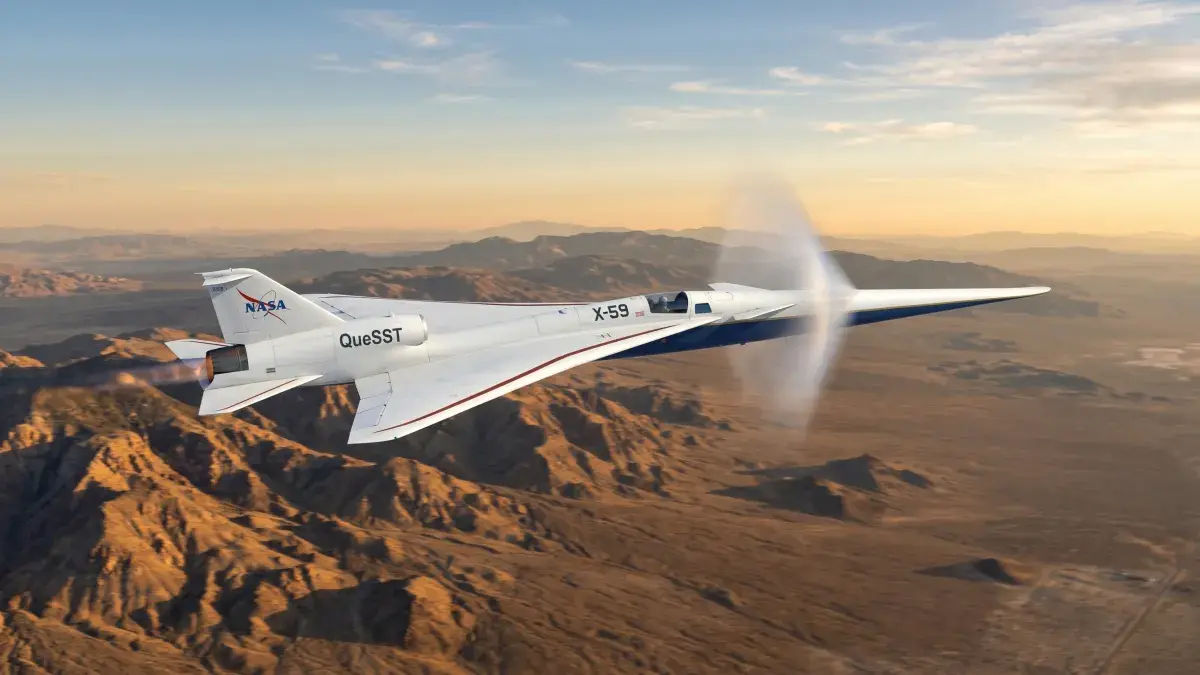
What is Quiet Boom: NASA's Windowless X-59 Jet Just Broke the Sound Barrier — and Maybe a 53-Year-Old Ban?
For the first time in 53 years, a brand-new civilian-class aircraft punched through the speed of sound over the United States on purpose — and almost nobody on the ground heard a boom. On Friday, June 5, 2026, NASA's X-59 quiet supersonic jet took off from Edwards Air Force Base in California, climbed to 43,400 feet, and nudged past Mach 1.1 — roughly 713 mph — during an 81-minute flight that the agency has been building toward for the better part of a decade. The needle-nosed, windowless experimental plane is the centerpiece of NASA's Quesst mission, and its whole reason for existing is to answer one stubborn question: can a supersonic aircraft trade the window-rattling sonic boom for something closer to a distant car door thudding shut?
That single flight, captured on livestream and replayed across every aviation and science feed by the weekend, is why "X-59" rocketed up the trends charts heading into June 7. It is not just a cool plane doing a cool thing. It is the most visible test yet of whether overland supersonic passenger travel — banned in the U.S. since 1973 — is about to come back. If you have ever idly wondered whether you will live to fly New York to Los Angeles in two hours, this was the week the question stopped being hypothetical.
What actually happened on June 5
NASA test pilot Jim "Clue" Less flew the X-59 from Edwards, with the flight beginning at 11:08 a.m. PDT. The team eased the aircraft through transonic speeds, then held it supersonic at about Mach 1.1 and 43,400 feet — the baseline conditions the plane will use later when it flies over actual American towns. Per Space.com and NASA's own mission blog, this first supersonic run was about flying qualities: confirming the aircraft behaves the way the models predicted as it crosses Mach 1, not yet about measuring the noise it makes. The mood inside the control room, by NASA's account, was less fireworks and more held breath — the kind of focused calm you would want if you were the one signing off on a one-of-a-kind aircraft going where it had never gone before.
The plane itself looks like nothing else in the sky. It is roughly 99 feet long, and almost a third of that is nose. There is no forward-facing cockpit window at all; the pilot flies using an eXternal Vision System, a 4K display fed by forward cameras. That bizarre silhouette is the entire engineering trick. By stretching and shaping the airframe, Lockheed Martin's Skunk Works designers prevent the shockwaves coming off the aircraft from merging into the two sharp pressure spikes that produce a classic double-boom. Instead they arrive at the ground spread out and softened — what NASA describes as a quiet "thump." Every curve, antenna placement, and even the position of the engine inlet on top of the fuselage was chosen to keep those shockwaves from stacking up, which is why the plane took years to design and looks more like a sculpture than a fighter jet.
The target number is a 75 effective perceived noise level (EPNdB) thump. For context, a conventional sonic boom from something like Concorde could exceed 105 PLdB — and decibels are logarithmic, so that gap is far bigger than it looks on paper. NASA's own comparison is that the X-59's signature should feel about as loud as a car door closing somewhere down the block. If the data backs that up, the entire 1970s rationale for banning supersonic flight over land starts to wobble.
Why the 1973 ban exists — and why it is suddenly in play
Civil supersonic flight over U.S. land has been illegal since 1973, when the FAA enacted 14 CFR § 91.817 in response to a string of incidents that convinced regulators sonic booms and populated areas did not mix. The most cited example: a 1968 Air Force Academy flyby that shattered roughly 200 windows and injured a dozen people. The rule did not cap speed; it effectively banned the boom, which amounted to the same thing for any commercial operator. For half a century, that single regulation is the reason your transcontinental flight still crawls along at the same cruising speed your grandparents flew.
That decades-old wall is now cracking on two fronts at once, which is a big part of why this story has legs. A June 2025 executive order directed the FAA to repeal the overland supersonic ban and replace it with a noise-based standard. And on the legislative side, the U.S. House passed H.R. 3410, the Supersonic Aviation Modernization Act, by voice vote in March 2026, instructing the FAA to rewrite its rules within a year so civil aircraft can exceed Mach 1 over land — provided no boom actually reaches the ground. Tech Times framed the timing bluntly: the X-59 went supersonic the same week Congress was actively moving to dismantle the very ban the aircraft was designed to challenge.
The X-59 matters here because regulators cannot write a sane "no boom on the ground" rule without real-world data on what a quiet thump actually does to the people underneath it. That is the data NASA is about to go collect. If you like keeping a scorecard of which way the political and policy winds are blowing on big tech-and-money stories, the supersonic fight is shaping up to be one of 2026's better ones — the same way watching the AI hardware arms race has been a running storyline all year. The money is paying attention too: aerospace and defense names are part of why broad market-index ETFs have a chunky industrials slice, and a viable supersonic market would ripple straight into those holdings.
What happens next: the part that affects you
Friday's flight kicks off an expanding test program. NASA has said it plans, within days, to fly the X-59 at "mission conditions" — roughly Mach 1.4 (around 925 mph) and 55,000 feet. From there, phase two is acoustic validation inside the restricted ranges around Edwards, expected to begin before the end of 2026 and run for roughly nine months. A specially instrumented F-15 carrying a shock-sensing probe on its nose will fly near the X-59 to measure its shockwave pattern up close, capturing the pressure signature in mid-air before it ever reaches the ground. NASA will pair those airborne readings with a ground array of microphones, building a detailed picture of how the thump propagates and softens on its way down — the raw evidence that any future rulemaking will have to lean on.
The phase everyone is actually waiting for is phase three: flying the X-59 over a handful of selected U.S. communities and surveying the residents about what they heard. That is the whole ballgame. NASA does not get to declare victory; the people living under the flight path do. The survey data then feeds into international aviation rulemaking, which is where the abstract engineering finally turns into airline schedules. It is a refreshingly human way to settle a physics question — fly the plane, then literally ask the neighbors.
And the airlines are already lined up. Boom Supersonic's Overture jet — designed to cruise around Mach 1.7 and seat 64 to 80 passengers — has racked up more than 130 orders from carriers including United, American, and Japan Airlines, with service targeted for the end of the decade. The X-59 is not a passenger plane and never will be; it is a flying physics experiment. But its data is the permission slip the whole industry needs. If you are the type who starts budgeting for the trips you dream about, a two-hour coast-to-coast hop is the kind of thing worth a line item — eventually.
The catch nobody is putting on the trailer
It is worth staying grounded. The X-59 flew once, at the low end of its envelope, and the headline milestone is "it works as predicted," not "supersonic flights start next year." The community-overflight phase has not started. The FAA still has to write and finalize new rules. And program delays have already pushed NASA's ability to influence international noise standards toward a meeting now scheduled for 2030 — a real, multi-year slip. The dream of a Mach-1.7 lunch meeting across the country is still firmly in the back half of this decade, at the earliest.
There is also an open economic question. Concorde was not killed only by noise; it was killed by economics — brutal fuel burn, limited routes, and ticket prices that only the very wealthy could stomach. Even a perfectly quiet supersonic jet has to clear that bar. If the first overland supersonic flights end up being a luxury product for a sliver of travelers, the cultural payoff may be smaller than the hype. It is the kind of "incredible engineering, uncertain market" story that rewards a little skepticism — the same instinct you would bring to any breathless new-technology-is-worth-paying-for pitch.
And let us be honest about the human side: shaving hours off a flight sounds like pure upside until you remember that "faster" usually means "more crammed into the same day." The same productivity culture that turned the commute into a second inbox will happily fill a two-hour transcontinental flight with three more meetings. Plenty of people are already trying to claw back attention rather than spend it faster — which is partly why tools built around deep focus and distraction-blocking have quietly become a 2026 staple. Speed is only a gift if you decide what to do with the time it frees up.
Why this one broke through the noise
Plenty of aviation milestones come and go without trending. This one stuck for a few reasons. First, the visual: a windowless, 99-foot dart with a nose longer than a school bus is genuinely strange and instantly shareable. Second, the "quiet boom" framing is a perfect one-line hook — it sounds almost paradoxical, which makes people click. Third, the timing with the congressional ban-repeal push gave news outlets a real stakes-and-consequences story instead of a press release. And fourth, it tapped a fantasy a lot of people quietly hold: faster travel without the downsides.
If the X-59's eventual noise data holds up, the practical upshot is enormous — coast-to-coast trips that take half as long, opening up routes that simply do not make sense at today's speeds. That is the kind of shift that reshapes how people think about distance, work travel, and even where they live. For now, though, the honest takeaway is narrower and still remarkable: on June 5, 2026, a plane built specifically to break the rules of supersonic flight quietly proved it can fly fast enough to test them.
Curious how much you actually know about the science of flight, speed, and the experimental aircraft that got us here? Take a spin through the interactive quizzes at quiz.thicket.sh and see how your aerospace trivia holds up — then come back to trends.thicket.sh for the next milestone, because the X-59's mission-conditions flight could land any day now.
Origin
NASA's X-59 quiet supersonic research aircraft completed its first supersonic flight on Friday, June 5, 2026, flying from Edwards Air Force Base in California with test pilot Jim "Clue" Less at the controls. The flight began at 11:08 a.m. PDT, lasted 81 minutes, and reached approximately Mach 1.1 (around 713 mph) at 43,400 feet — the baseline conditions for later community overflights. The X-59 is the centerpiece of NASA's Quesst mission, built by Lockheed Martin's Skunk Works to fly supersonic while producing a quiet "thump" (target ~75 EPNdB) instead of a loud sonic boom. Verified via NASA's official mission page and aerospace coverage from Space.com, ScienceDaily, Air Data News, autoevolution, TechEBlog, SciTechDaily and Tech Times. The flight landed amid an active U.S. policy push — a June 2025 executive order and the House-passed H.R. 3410 (Supersonic Aviation Modernization Act, March 2026) — to repeal the FAA's 1973 ban (14 CFR § 91.817) on civil overland supersonic flight.
Timeline
Why Is This Trending Now?
NASA's X-59 broke the sound barrier for the first time on Friday, June 5, 2026 — two days before the June 7 trend window — and the livestreamed milestone was replayed across every aviation and science feed all weekend. Three forces stacked into the same news cycle: (1) the visual spectacle of a windowless, 99-foot, needle-nosed experimental jet doing something genuinely new; (2) the irresistible "quiet boom" hook — a supersonic plane engineered to whisper instead of bang; and (3) the timing, landing the same week the U.S. House moved (H.R. 3410) and the White House directed the FAA to dismantle the 53-year-old ban on overland supersonic flight that the X-59 was literally built to challenge. Together that turned a technical flight test into a stakes-and-consequences story about whether coast-to-coast supersonic passenger travel is finally coming back.
Frequently Asked Questions
Sources
- NASA - X-59 Aircraft Flies Supersonic for First Time (official, June 5, 2026)
- Space.com - Going supersonic! NASA's X-59 jet breaks sound barrier for the 1st time
- ScienceDaily - NASA's X-59 is about to break the sound barrier for the first time
- Air Data News - NASA's X-59 breaks sound barrier for first time
- Tech Times - NASA X-59 Supersonic Flight Imminent as Congress Moves to Lift 53-Year Ban
- TechEBlog - NASA's X-59 Quesst Aircraft Goes Supersonic for the First Time
- autoevolution - NASA's Windowless Quiet Supersonic Aircraft Flies Faster Than Mach 1 for the First Time
- AIAA - U.S. House Advances Legislation to Lift Ban on Supersonic Travel Over Land
- Wikipedia - Lockheed Martin X-59 Quesst
- NASA - Quesst: The Mission