What is 'Loving Life' to 'Loving Life Again': A Two-Year Trend Cycle?
Three syllables. The phrase 'loving life' has been on TikTok continuously since at least 2021 — almost always as a caption, almost always with some ironic distance, almost always paired with a moment of obvious not-loving-life. By 2024 it had crystallized into a specific kind of exhausted-millennial humor: caption your most defeated-looking selfie 'loving life,' watch the comments fill with people sharing their own. The format was so saturated that nobody noticed it had become its own meta-trend.
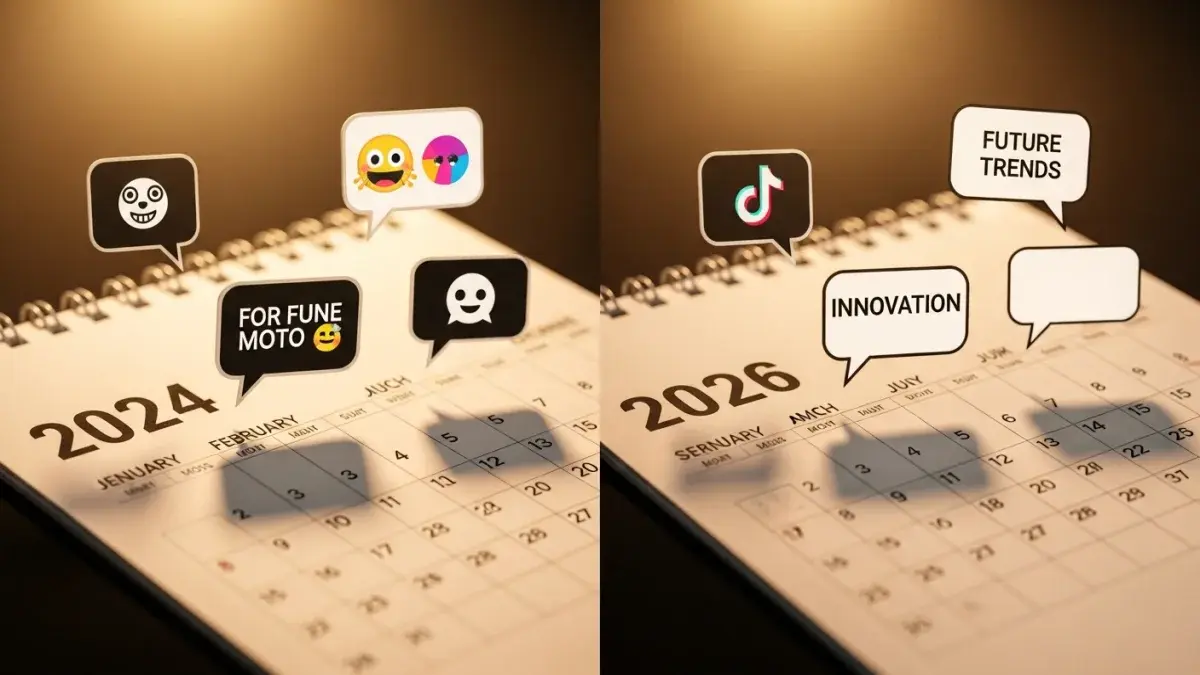
Then in February 2026 Ella Langley released a song called 'Loving Life Again' and the same three syllables — with the addition of one word — became the soundtrack to the opposite emotional position. Earnest. Specific. Quietly surprised at being okay. The three-word version was self-deprecating; the four-word version is sincere. The cultural arc between them is one of the cleanest available signals of how Gen Z and elder-millennial mood has shifted between 2024 and 2026, and it is a model case study for how a single phrase can travel across multiple platform cycles with totally different emotional charges.
This piece walks the timeline from the original 'loving life' meme in 2021-2024, through the inflection moment of 2025, to the current 'Loving Life Again' moment we covered in our main 'Loving Life Again' explainer.
2021-2024: 'loving life' as exhausted-millennial caption
The earliest documentable use of 'loving life' as a TikTok caption convention traces to early 2021 pandemic-era content — captioning a photo of yourself eating cold leftovers in pajamas at 4 PM 'loving life :)' was a recognizable joke by mid-2021. The format spread through 2022 across millennial creator-scenes (Sarah Cooper-style observational comedy creators, the early generation of 'mom-tok' burnout content) and consolidated by 2023 as a caption convention used several million times per month.
The 2024 peak version of 'loving life' was attached almost exclusively to defeat-coded content. Stuck in airport. Crying in car. Walked-into-meeting-with-spinach-in-teeth. Tax-season anxiety. The phrase was so consistently used in defeat-context that 'loving life' as a sincere caption would have read as parody by 2024. The convention had locked in.
The format also became a kind of class signal. 'Loving life' was solidly elder-millennial and lifestyle-creator vocabulary — not Gen Z's speech pattern, which used different sarcasm tools (the deadpan emoji-less 'this is so demure' format, the unironic 'I am literally him' Mr. Beast pastiche, the exhausted-Slack 'lol' deployment). When Gen Z creators picked up 'loving life,' it usually read as ironic appropriation of millennial-cringe vocabulary.
2025: the inflection moment
2025 was the year the original 'loving life' caption convention started to get tired without yet being replaced. Several reasons. First, post-2024 election fatigue produced a broad creator-scene retreat from explicitly-political defeat content, and 'loving life' as caption had drifted into the orbit of mild-political-defeat content. Second, lifestyle-creator scenes in 2025 began rebuilding around 'small-good-thing' content — quietly noticing a moment of competence, a meal that came out, a friend who showed up — which the existing sarcastic 'loving life' caption couldn't carry without sounding tonally wrong.
By late 2025 the caption convention was still in use, but it was visibly stale. Comment sections had started using 'this is such a 2024 caption' as a put-down. The phrase was pre-revival territory — too well-known to be funny anymore but not yet repurposed.
February 2026: 'Loving Life Again' lands
Ella Langley's song dropped February 14, 2026 — a deliberate Valentine's Day release, lead single from her in-progress country-pop crossover record we covered in her career-arc piece. The song's chorus phrase is 'I'm loving life again' — past tense of love, present-progressive tense of life, with the word 'again' carrying the weight of the whole sentence.
The 'again' is the inversion mechanic. 'Loving life' as a caption in 2024 implied 'definitely not loving life right now and being sarcastic about it.' 'Loving life again' implies 'I was not loving life for a while, and I am now, and I am noticing it.' The grammatical relationship is parent-child: the new phrase contains the old phrase but inverts its emotional charge. Once both phrases coexist in the same cultural moment — which they did from late February 2026 onward — the older phrase becomes effectively retired. Sarcasm-coded uses of 'loving life' since March 2026 have read as off-key, in the same way that sarcasm-coded uses of 'this is fine' became off-key after the 2017 'this is fine' meme had consolidated.
Why the timing worked: Gen Z mood shift evidence
'Loving Life Again' worked partly because it landed exactly when a measurable mood shift was already underway. Multiple polling indicators show 2025-2026 Gen Z self-reports moving from a 2022-2024 trough on subjective-wellbeing scales toward a more cautiously-optimistic position. American Psychological Association Stress in America survey for 2026 (published February 2026) showed Gen Z mental-health self-reports posting their first year-over-year improvement since 2019. Gallup's Q1 2026 satisfaction tracker showed similar small-but-real improvements.
The mood shift is small in absolute terms but big in derivative terms — that is, the change is more meaningful than the level. People notice when they go from getting worse to getting better. They do not notice when they continue getting worse at the same rate, and they do not notice when they continue feeling fine. The 'I am loving life again' frame captures the derivative-improvement experience exactly. Not 'I am happy' (which would have read as too earnest in any year). 'I am happier than I was.'
The format-fit: lifestyle creators were already moving this direction
The other reason the timing worked is that lifestyle-creator content in 2025-2026 had already moved toward 'small-good-thing' format. The breakout creator examples in this lane include the soft-cooking-content creators, the morning-routine-without-a-gimmick creators, and the 'I tried something this week and it was nice' first-person mini-essays. None of those formats fit a sarcastic 'loving life' caption. All of them fit 'loving life again' as audio.
This is why the soundtrack-trend pattern caught immediately rather than struggling — the format the audio fit was already saturated with creators looking for the right audio. We covered the broader pattern in our soundtrack-trend pattern explainer, and the structural-identity comparison to Chappell Roan's 'Pink Pony Club' second-cycle trend in our side-by-side piece.
The retired version, the active version, and what comes next
As of late April 2026, the original 'loving life' caption is retired in active TikTok usage — still used occasionally, but read as dated. The 'Loving Life Again' soundtrack trend is in late Step 4 / early Step 5 of its arc and will saturate in early-to-mid May. The four-word phrase is currently the dominant form.
What comes next is the standard post-saturation trajectory. The audio will fall out of trend rotation but the phrase 'loving life again' will persist as a cultural reference for the rest of 2026, in the way 'this is fine' persisted after its 2017 trend or 'no thoughts head empty' persisted after its 2020 trend. The phrase will probably get some second life in 2027 as a self-referential callback, with creators captioning content 'remember when we were loving life again' — a third-order ironic deployment that loops back to the original 2024 sarcasm-mode by treating the 2026 sincerity as nostalgic.
If that pattern plays out, the full arc will look like: 2021-2024 sarcastic 'loving life'; 2026 sincere 'loving life again'; 2027 self-aware-nostalgic 'remember loving life again'; eventual full retirement around 2028-2029. Three-and-a-half cycles for one phrase, which is roughly the average lifespan of a phrase that achieves multi-cycle TikTok penetration. (The 2017 'this is fine' arc is now in roughly its fourth cycle and will probably retire around 2027-2028 by the same metric.)
What this teaches about phrase-trends generally
The 'loving life' to 'loving life again' arc is unusual in one specific way — it is one of the cleaner examples of a phrase getting revived with an inverted emotional charge by adding one word. Most phrase-trends fade or get retired without being repurposed. The inversion-by-suffix mechanic works only when the sarcastic original was widely-enough used that the new sincere version can rely on cultural pre-loading.
'I am' became 'I am literally him' (sincere → grandiose-sincere). 'Tell me you don't X without telling me' became 'tell me you X' (challenge → declaration). 'You can't sit with us' became 'you can sit with us' (Mean Girls reference → inclusion-positive). Each is a small grammatical shift inverting the emotional charge of a saturated phrase.
The 'loving life' to 'loving life again' shift is the same mechanic. It is the cleanest current example because the inversion happened on a defined date (February 14, 2026), can be cleanly attributed to a single song, and produced a measurable emotional repositioning rather than just a stylistic refresh. That makes the case-study unusually useful for thinking about how phrases evolve across multi-year platform cycles.
Origin
The phrase 'loving life' as a TikTok caption convention traces to early 2021 pandemic-era millennial-creator content. It consolidated through 2022-2023 as a caption attached almost exclusively to defeat-coded content, peaked in 2024, and showed visible fatigue through 2025. Ella Langley's 'Loving Life Again' was released on February 14, 2026, and the four-word phrase began displacing the three-word phrase in active TikTok usage by mid-March 2026. By late April the inversion is largely complete — sarcastic uses of 'loving life' read as dated, sincere uses of 'loving life again' are platform-wide.
Timeline
Why Is This Trending Now?
The phrase-evolution timeline is trending on TikTok-discourse Twitter and r/popheads in late April 2026 because the cultural-historian framing of the 2024-vs-2026 contrast has produced significant engagement. Several 30K-50K-follower 'phrase tracker' creators have made multi-part videos walking through the arc, which has pushed the meta-conversation into the discovery feed. The 'why is loving life again so different from loving life' search query is up roughly 10x month-over-month per Google Trends. The conversation also intersects with broader Gen Z mood-shift commentary tied to APA's February 2026 Stress in America numbers showing first year-over-year improvement since 2019.