What is How Drinks Became Collectibles: The Stanley → Owala → Frank Green Flywheel?
If you had told a beverage industry analyst in 2021 that Stanley — a 113-year-old company best known for the indestructible green thermos that construction workers strapped to lunchboxes — would be the most-discussed lifestyle brand in America by Black Friday 2023, they would have laughed. By the end of 2023 the laughing had stopped. Stanley's annual revenue had climbed from roughly $70 million in 2019 to over $750 million in 2023, an increase driven almost entirely by a single SKU (the Quencher H2.0 FlowState 40-ounce tumbler) marketed almost entirely to women through TikTok and Instagram-led brand partnerships. By Christmas Eve 2023, viral videos showed lines of women camping outside Target locations at 4am for limited-edition Stanley × Starbucks pink Quenchers, fights breaking out over remaining stock, and Stanley resellers listing the cups for $200-400 on eBay within hours of the drops.
That Christmas Eve was the moment the beverage industry — and adjacent industries — collectively realized that the rules had changed. A water bottle was now a collectible. The collectibility was not incidental to the product. The collectibility was the product. Within twelve months, the Stanley playbook had been reverse-engineered, extended, and applied to nearly every adjacent category, and by Q1 2026 the same playbook had jumped from the container to the liquid itself. This is the story of how that flywheel got built.
2019-2022: how Stanley turned a 113-year-old thermos brand into a lifestyle drop
The Stanley turnaround began with a website. The Buy Guide — a small affiliate-marketing site run by three women in Utah — had been quietly recommending the Stanley Quencher to their female readership since 2017. The Quencher, originally launched in 2016, had been a commercial flop on its initial run; Stanley had even discontinued it briefly in 2019. The Buy Guide founders bought a wholesale order in 2020 and resold it through their own channels, the orders sold out, and the women approached Stanley directly proposing that the brand pivot the Quencher's marketing toward women, lifestyle, and color rather than men, durability, and rugged outdoors imagery. Terence Reilly, who had joined Stanley as president after running Crocs's marketing turnaround, bought in.
The pivot was textbook. Stanley dropped the Quencher in dozens of new pastel colorways, partnered with influencers in the parenting and lifestyle verticals (not the outdoors vertical), and started doing limited-color drops timed to retail calendars (Valentine's pinks, summer pastels, fall earth tones, winter jewel tones). The Quencher's 40 oz capacity, narrow base that fit in car cup holders, straw, and handle were marketed not as utility features but as identity features — the proof that you were the kind of woman who hydrated, who showed up to soccer practice with the right cup, who knew about the Target drop. Sales went from $73M in 2019 (the year before the pivot) to $94M in 2020, $194M in 2021, $402M in 2022, and over $750M in 2023.
By 2022 the cup had its own influencer subgenre on TikTok — #StanleyTumbler had 1.4 billion views by Q4 2023 — and a robust collector community that tracked drop schedules, traded swaps, and built spreadsheets of every colorway ever produced. The 2023 Stanley × Starbucks Cosmo Pink Quencher (released around Valentine's Day) is the moment most often cited as the inflection: limited stock, in-store-only at Target, single-day distribution, and chaos that produced the 4am-camping videos that made national news. The product retailed for $50; the resale market hit $200-400 within hours.
2023-2024: Owala enters with a cleaner functional spec and a sharper drop strategy
Stanley's success cracked the category open. The clearest beneficiary was Owala, a smaller brand owned by Trove Brands (the parent company of Blender Bottle). Owala launched its FreeSip line in 2020 with a genuinely novel functional spec — a hybrid lid that could either be sipped from a built-in straw or flipped open into a wide-mouth spout, both controlled by a single push-button. The spec was actually better than the Stanley Quencher's straw-only design, and a vocal corner of the category had been quietly evangelizing it since 2021. When Stanley's 2023 Christmas chaos sent shoppers searching for alternatives, Owala was the first answer the algorithm produced.
Owala's 2024 strategy borrowed Stanley's drop mechanics directly but executed them with more restraint. Limited colorways, in-store-only at Target with online preview, and a clearer brand identity built around outdoorsy-but-cute (rather than Stanley's pivot toward suburban-mom). The 'Cinderella' purple-and-pink colorway (Q2 2024) and the 'Sandy Shores' beige-and-coral (Q3 2024) both hit secondary-market prices of $90-120 against a $30-35 retail. Owala revenue grew from approximately $40 million in 2022 to a reported $300 million annualized by mid-2025. The category had its second major collectible brand.
2024-2025: Frank Green builds the customization layer
Frank Green, an Australian brand founded in 2014 that had been quietly available in Whole Foods and Anthropologie since 2020, took a different angle on the same trend. Instead of competing on drop scarcity, Frank Green built a customization platform. Users can configure their bottle from 50+ colorways, choose from multiple lid styles, add monogramming, and order — for roughly $40-55 — a bottle that no one else owns in exactly that combination. The model trades drop-culture FOMO for individualization, and it has worked: Frank Green's US revenue more than doubled in 2024 and again in 2025 (from approximately $30M to $80M to ~$170M), with a customer base that skews younger and more design-conscious than Stanley's.
The Frank Green model is significant because it points at where the category goes after drop fatigue sets in. Drop scarcity works as a primary growth mechanism for two to three years before the audience starts to resent the manufactured-shortage dynamics. (The 2024 backlash to Stanley's lead-content controversy and the broader 'is this just landfill' wave of criticism both compressed Stanley's growth in 2024-25.) Customization is more durable. It produces a bottle that is identity-signaling without requiring the customer to participate in midnight drops or pay resale markups.
The four-mechanic playbook
Across Stanley, Owala, and Frank Green, the same four mechanics show up:
Limited-edition scarcity. Drop-only colorways, retail-exclusive partnerships (Target, Starbucks, Pottery Barn, Erewhon), and explicit waitlist mechanics. Scarcity converts a $30-50 cup into a $200 secondary-market object, and the secondary-market premium becomes part of the brand's social proof.
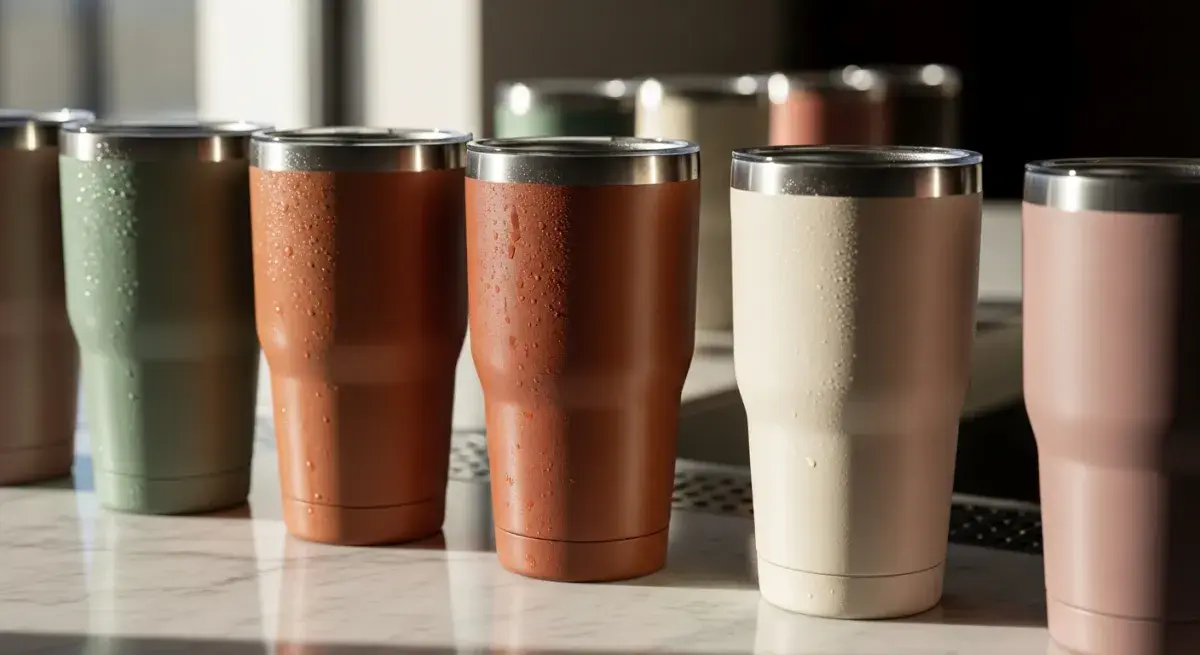
Instagrammable color palettes. Pastels for spring, jewel tones for fall, earth tones for the wabi-sabi-adjacent customer, sage-and-terracotta for the design-Pinterest customer. Color is no longer SKU variance; it is the central marketing variable.
Creator and celebrity equity. Stanley partnered with influencers; Owala partnered with smaller niche creators; Frank Green has done celebrity collabs (notably with Selena Gomez's Rare Beauty in 2024). The pattern is to give creators not just affiliate cuts but in some cases brand equity or recurring royalties.
Functional differentiation as collectible spec. The Quencher's 40 oz / car-cup-holder / straw, the FreeSip lid, the Frank Green ceramic interior — each functional spec doubles as a collector talking point. The functional choice and the aesthetic choice are inseparable. Connoisseurship is part of the category.
Q1 2026: Cardi B and Zevia signal the playbook jumping from container to liquid
The most interesting development of 2026 so far is that the same four mechanics are now being applied to the liquid itself, not just the container. In Q1 2026, Cardi B took a reported equity stake in Zevia, the zero-sugar plant-based soda brand. The structure of the deal — Cardi B as part-owner and ongoing creative collaborator, not just spokeswoman — is a near-direct port of the model that Selena Gomez used with Rare Beauty in cosmetics, that Ryan Reynolds used with Aviation Gin, and that Jessica Alba used with The Honest Company in earlier celebrity-equity cycles. What is new is applying it to functional beverages specifically, in a market where the audience has just been trained by Stanley and Owala to treat beverage containers as identity objects.
The Cardi-Zevia deal is the clearest signal yet that beverages themselves — not just the cups they are drunk from — are now positioned to move into collectibility. The adjacent moves point the same direction. Olipop and Poppi (the prebiotic sodas that have been driving the functional-beverage growth wave for three years) both run limited-edition flavor drops with collector packaging. Liquid Death has been running its 'death to plastic' branding combined with limited-edition pricing tiers and ongoing celebrity equity rounds (Tony Hawk, Steve Aoki, Wiz Khalifa as investors). Athletic Brewing is running the same playbook with NA beer. Erewhon has built an entire luxury-smoothie program around drops that retail at $19 and resell as identity signals on TikTok. The infrastructure is already there. Cardi B's Zevia deal is the moment the celebrity-equity model arrives in the category.
Why women drove this
The structural fact that distinguishes the 2022-2026 beverage-collectibles wave from earlier collectibles cycles (Beanie Babies, Pokemon cards, sneaker drops) is that it was driven by women. Stanley's pivot to women is the single most-cited business case study in beverage marketing of the decade. The reasons are partly demographic (women aged 25-45 control household discretionary spending) and partly structural — the wellness, hydration, and self-care discourses that have dominated the 2020s gave women a culturally legitimized lane through which to spend on a $50 cup. Buying yourself a Stanley wasn't 'consumerist'; it was 'taking care of yourself' and 'making sure you hydrate.'
This matters for forecasting. Where the wellness/self-care framing extends, the collectibles flywheel can extend with it. Beverage is the obvious next category — the Cardi-Zevia move proves it. Beauty water and functional beverages are already being primed (see the recent waves around Poppi, Olipop, Magic Spoon's beverage extensions). Collagen powders, electrolyte mixes, and adaptogen drinks are queued up next. The category that has not yet been cracked but is structurally adjacent is functional snacks — protein bars, the Aplós-Apothékary class of NA spirits, and high-end functional candy are all candidates for the same playbook through 2027.
What ends the cycle
Every collectibles cycle ends. Beanie Babies ended in 1999; sneaker drops cooled in 2022-23; the NFT collectibles wave ended in 2022. The mechanism is always the same: the secondary-market premium collapses when supply outpaces demand, and the drop mechanics that worked when scarcity felt real stop working when the audience clocks the manufactured shortage. Stanley already saw the early version of this in 2024 — the lead-content controversy compressed growth, the 'is this just landfill' backlash gained traction, and growth slowed materially in 2024-25.
The brands that survive past their flywheel cycle are the ones that successfully convert collectibility into ongoing brand affinity (Lululemon did this in 2010s yoga apparel; Nike has done it repeatedly with sneakers; Apple has done it with phones). The ones that don't survive are the ones whose entire value was the scarcity, with nothing underneath it (the post-2022 NFT crash). Stanley's 2026 question is whether Quencher buyers will continue to be Stanley buyers when the drops stop feeling scarce. Owala and Frank Green face the same question one product cycle later. Zevia and the next wave of liquid-collectible brands face it one cycle after that.
The flywheel is real. The cycle has 18-36 months of runway in any single category. Watch beauty water and functional snacks next.
The bottles driving the flywheel
If you want to actually own one of the cups this article is about — at retail, not resale — here are the two SKUs at the center of the moment. Both are widely available on Amazon (which is where most non-drop colorways live anyway).
- Stanley Quencher H2.0 FlowState 40 oz (Charcoal) — The cup at the center of the 2023-2024 cycle. 40 oz capacity, narrow base that fits car cup holders, three-position FlowState lid with reusable straw. Charcoal is the perennially-stocked colorway; limited drops sell out in minutes. Around $45-50 retail.
- Owala FreeSip Insulated 24 oz Water Bottle — The hybrid-lid spec that converted Stanley defectors in 2024. Push-button lid does both straw-sip and wide-mouth swig from the same opening. The functional spec people actually argue is better than the Quencher. Around $30-35 retail.
As an Amazon Associate, we earn from qualifying purchases. Frank Green configures-to-order on their own site, so it is not in this list — but the two above cover the dominant US-market cups discussed in the article. Prices shown are typical.
For more on related cultural shifts driving this consumption pattern, see our explainers on loud luxury, underconsumption-core (the backlash mood), and de-influencing.
Origin
The beverage-collectibles wave traces to Stanley's 2020 marketing pivot, but the conditions that made it possible were laid earlier. The Buy Guide — a Utah-based affiliate site run by Ashlee LeSueur, Linley Hutchinson, and Taylor Cannon — bought a wholesale order of the Quencher in 2020 after their female readership repeatedly asked about it. They resold it through their site, sold out within hours, and approached Stanley directly. Terence Reilly (joining as president from Crocs) authorized the pivot. The flywheel began in earnest in 2021, hit cultural saturation with the 2023 Stanley × Starbucks Cosmo Pink drop at Target, expanded into Owala (2023-24) and Frank Green (2024-25) in adjacent positioning, and jumped from container to liquid with the Cardi B / Zevia equity announcement in Q1 2026.
Timeline
Why Is This Trending Now?
Multiple converging signals make this the right moment to write the meta-explainer. First, Cardi B's Q1 2026 equity stake in Zevia is the clearest signal yet that the celebrity-equity model is jumping from beverage containers to the beverages themselves. Second, Qwoted (the journalist-source platform) has had a sustained uptick in beverage-industry queries from culture and business journalists through Q1-Q2 2026, indicating active media interest in the category. Third, Stanley's growth has visibly compressed in 2024-25 (down from 2022-23 hypergrowth), which makes 'where does this go next' the obvious question every adjacent operator and analyst is now trying to answer. Fourth, the wabi-sabi / earth-tones aesthetic shift in 2025-26 is producing a clear opening for next-generation drink brands that lean into the post-Stanley aesthetic register.
Frequently Asked Questions
Sources
- CNBC — How Stanley turned a 110-year-old thermos brand into a $750 million viral sensation
- Bloomberg — Owala Tumbler Sales Jump as Stanley Cup Mania Cools
- Vogue Business — Frank Green's Customization-First Approach to the Tumbler Wars
- WWD — Cardi B Takes Equity Stake in Zevia in Beverage's Latest Celebrity Deal
- The Wall Street Journal — Inside the Stanley Cup Pivot: How a 113-Year-Old Brand Became Lifestyle's Defining Object
- Modern Retail — How Owala Built the Anti-Stanley Brand Identity