What is The CORTIS 'REDRED' Wiggle-Ears Challenge Is Eating TikTok — And BTS Just Made It Bigger?
If you have opened TikTok in the last week and seen anyone — a K-pop idol, a middle schooler in suburban Ohio, a 40-year-old dad in his kitchen — pulsing their flat palms next to their ears like nervous rabbit ears while a snapping electronic beat plays, you have met the CORTIS 'REDRED' challenge. As of this week it has crossed roughly 13,000 distinct TikTok videos, the music video has done 10 million YouTube views in 12 days, and BTS members J-Hope and Jungkook have both posted versions — Jungkook's casually filmed at Incheon Airport on his way out of the country, which is, in the grand tradition of Jungkook airport content, exactly the kind of thing that breaks an algorithm. What is interesting about this one is not the dance itself, which is deliberately stupid. It is what the dance is doing to two parallel stories: the slow-building 2026 K-pop dance challenge revival, and the very specific commercial test of whether HYBE's third boy group can actually break out in a year that has otherwise been dominated by solo artists and country-pop crossovers. We have been covering the latter trend in pieces like the Ella Langley vs Morgan Wallen chart battle and the 'Loving Life Again' explainer. REDRED is the counterweight — proof that short-form video, K-pop, and a deeply silly choreography hook still have the most reliable virality engine in pop in 2026.
What the wiggle-ears dance actually is
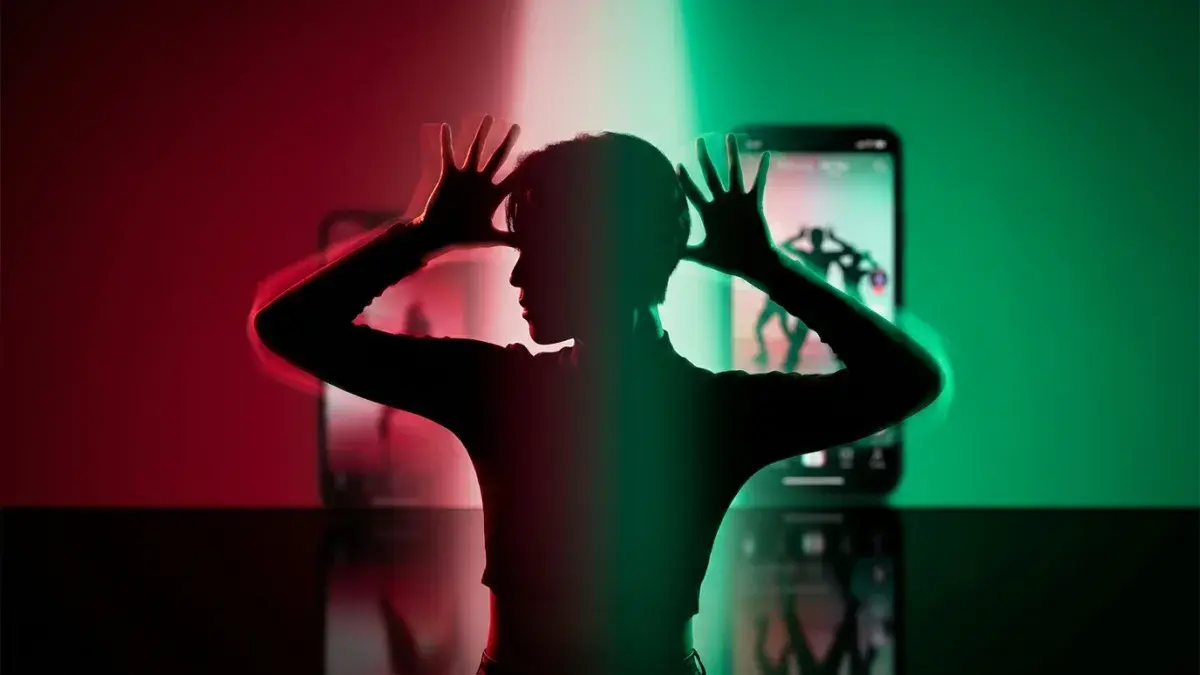
The choreography for REDRED has a full routine, but the part that travels is the bridge: hands held flat next to the head at roughly ear level, palms forward, then a small rhythmic flap — outward, inward, outward, inward — synced to the song's stutter-step beat drop. That is it. No body roll, no footwork, no costume, no choreo background. You can do it on a couch. You can do it walking through an airport. You can do it badly and the badness is part of the joke. It is the lowest-friction dance challenge K-pop has produced since the BTS 'Permission to Dance' shoulder-bounce or the BLACKPINK 'Pink Venom' shimmy, both of which followed the same template — one micro-gesture, no full-body commitment, executable in a 5-second clip.
CORTIS themselves have said in interviews that the gesture is meant to look like an animal flicking its ears at the 'REDRED' (bad things) and pivoting toward 'GREEN' (good things). The song's actual thematic frame is a kid sorting good influences from bad ones — green for go, red for stop — which is wholesome to the point of being almost off-brand for a HYBE debut act. The dance is the entry point; the song's message lives in the lyrics, which the algorithm is mostly ignoring.
Who CORTIS actually is
This is the part most casual viewers do not know yet. CORTIS is HYBE's third boy group — after BTS and TXT — debuted on August 18, 2025 under BIGHIT MUSIC with the single 'What You Want.' Five members, all teenagers: Martin (leader, born 2008), James (oldest, born 2005, Thai-Chinese background), Juhoon, Seonghyeon, and Keonho (maknae, born 2009 — 16 years old when REDRED dropped). The group name is an acronym: COLOR OUTSIDE THE LINES. The unusual part is that all five members are credited as songwriters, choreographers, and music video directors on REDRED. HYBE has been deliberately positioning this group as a creative-led act rather than a producer-led one, which matters for the next thing on this list.
That creator-led framing is what makes the wiggle-ears dance feel different from a typical K-pop label rollout. The dance was not handed to CORTIS by an external choreographer with a viral playbook. The members made it. That detail, surfaced repeatedly in Korean entertainment press in the past two weeks, has driven a lot of the secondary 'wait, the kids made this themselves?' coverage that keeps pushing the story back into algorithm feeds.
The April-to-May timeline (this is the part that matters)
This is a real-time story. Here is the actual sequence:
- April 16, 2026: CORTIS releases the mini-album 'GREENGREEN' with REDRED as the title track. Initial reception is moderate by HYBE-debut standards. The music video performs respectably but does not immediately viral.
- April 22-25: The dance challenge starts circulating on Korean TikTok. Early adopters are mostly K-pop dance cover accounts. Hashtag #cortis_redred picks up momentum.
- April 25: BTS's J-Hope posts the challenge on his personal TikTok. Within hours the video passes 15 million views. This is the inflection point — every major Korean entertainment outlet pivots to covering REDRED as the dance challenge of the month.
- April 27-28: Tomorrow X Together members Beomgyu and Hueningkai post their versions. ENHYPEN's Ni-ki posts his. The HYBE family pile-on becomes a story in itself.
- Late April / early May: Jungkook does the dance at Incheon Airport in a casual outfit, gets caught on fan-cam, the clip detonates. Non-K-pop creators start posting versions — including Western influencers and meme accounts who have no prior K-pop content.
- May 3: The REDRED music video crosses 10 million YouTube views (12 days post-release).
- Mid-May: REDRED enters the Melon Top 5 — a milestone CORTIS had not previously hit. The chart entry is unusual because Melon historically rewards streaming sustained over weeks, not viral spikes, which means the TikTok momentum has actually converted to listening behavior in Korea.
- This week (May 14-21): The cross-genre adoption phase. Non-K-pop creators, brand accounts, and parody videos saturate For You Pages globally. The dance is now visible enough that 'what is the ear flap dance?' is itself a search query.
Why this one broke when most K-pop challenges don't
K-pop labels have been engineering dance challenges for years and most of them stay inside the K-pop bubble. REDRED escaped the bubble for a stack of reasons that are worth being specific about.
The dance is genuinely low-friction. Compare the wiggle-ears to the IVE 'Baddie' point choreography or the LE SSERAFIM 'Easy' chair routine — both required some physical commitment and looked weird if you did them in normal clothes in a normal room. The wiggle-ears looks fine and looks slightly funny anywhere. That matters because the median TikTok poster is not a trained dancer in a studio. The median TikTok poster is in their bedroom, in a parking lot, or in line for coffee.
The HYBE-family adoption sequence was real, not staged. When labels coordinate cross-group challenge posts in advance, the timing is usually obvious — five idols from three groups posting within an hour of each other. The CORTIS adoption was spread across days, included casual fan-cam content (Jungkook at the airport) rather than studio-filmed challenges, and read as senior idols genuinely supporting a new debut act rather than a coordinated marketing push. That authenticity signal traveled.
The members are very young, which made the 'they wrote this themselves' angle land harder. A 17-year-old leader and a 16-year-old maknae writing their own choreography is a story. It triggered exactly the kind of secondary press coverage — explainer pieces, profile stories, 'meet CORTIS' content — that takes a music release from a one-day algorithm hit into a multi-week story. We saw a similar 'wait, the kids made this themselves' arc with the early phase of aura farming on TikTok and with the original spread of the 6-7 meme earlier this year.
The song itself is short, repetitive, and clipped. REDRED's hook is 18 seconds long if you isolate it. TikTok's algorithm rewards content that loops cleanly inside its native 15-30 second sweet spot. The bridge section that contains the wiggle-ears choreography is exactly that length and loops back to itself without an awkward cut. This is producer-craft, not luck — but it is the kind of producer-craft you only notice when it works.
The bigger pattern: K-pop dance challenges are back as a Western-export format
From roughly 2022 to early 2025, K-pop dance challenges plateaued as a cross-cultural export. The challenges existed, they got millions of views inside K-pop fandom, and they mostly stayed there. The breakouts that crossed over (PSY-era 'Gangnam Style,' the BTS 'Dynamite' era, the BLACKPINK 'How You Like That' point choreo) felt like exceptions rather than a rule. The pattern in 2026 is shifting.
aespa's 'Whiplash,' NewJeans' 'Supernatural,' and now CORTIS's REDRED have all crossed the K-pop bubble through dance-challenge mechanics that work in non-K-pop contexts. The common feature is that all three are short, looping, executable-in-15-seconds moves rather than full choreography routines. The Western TikTok creator economy has become much more permeable to K-pop content than it was even 12 months ago, and the simple-gesture format is the bridge.
This is the same general pattern we have written about in our decade-long look at TikTok soundtrack trends: songs travel further when the associated gesture is small, dumb, and physically forgiving. REDRED fits the pattern perfectly.
The commercial stakes for HYBE and CORTIS
For HYBE specifically, REDRED is a real test. BTS members are in and out of active group activity. TXT's commercial trajectory has been good but not transformative. ENHYPEN sits under HYBE's Belift Lab joint venture, which is structurally one step removed. CORTIS is the first new full HYBE-house boy group launch since TXT in 2019, and a successful breakout would give HYBE its first true post-BTS flagship act under direct label control.
The viral metrics are the easy part. The harder question — and the one we will probably know the answer to within the next 60-90 days — is whether REDRED converts into sustained album sales, concert-ticket demand, and brand-endorsement deals at HYBE-flagship scale. The Melon Top 5 entry suggests that conversion is starting. The next test is the album's second-week sales numbers and whether GREENGREEN holds in the Hanteo chart through June.
How to actually do the dance (if you must)
This is the entire instruction set. Hands flat, palms forward, raised to ear level on either side of your head. On the beat — and the beat in question is a four-count stutter pattern, the part of the song that goes chk-chk-chk-chk right before the chorus kicks back in — open your fingers slightly and pulse the hands outward and inward, like you are pretending your hands are rabbit ears reacting to a sudden noise. The pulse should be a small motion, maybe 6-8 inches of range, sharp on the beat rather than smooth. Two pulses outward, two inward, repeat for the 4-count phrase.
That is it. If you feel like you are doing it wrong, you are probably doing it right. The dance only looks bad if you take it seriously.
What to watch next
Two things are worth tracking over the next 30 days. First: whether the dance survives past the cross-genre saturation peak. Most viral challenges go through a predictable arc — early adopters, mainstream pile-on, peak, then brand-account adoption (which is usually the kiss of death). REDRED is currently in the brand-account adoption phase, which means peak fatigue is probably 7-14 days out.
Second: whether CORTIS gets a follow-up release scheduled to capitalize on the moment. The K-pop industry's standard playbook for a debut-act breakout is to follow within 8-12 weeks with a second mini-album that retains the breakout track's musical identity. If HYBE pulls that trigger by August, CORTIS becomes a real long-arc story. If they wait until late fall, the moment will have cooled and they will be starting over.
For now, the takeaway is simpler. A five-member teen boy group that wrote their own song, choreographed their own dance, and released it in mid-April just landed the biggest cross-genre dance challenge of 2026 so far — without a Western co-sign, without a viral-marketing campaign, and without the kind of producer-driven choreography that K-pop usually engineers for export. That is unusual. Whether you like the song or not, the wiggle-ears flap is the dance of May 2026, and at the current trajectory it is going to outlast the month.
Origin
CORTIS, the third HYBE/BIGHIT Music boy group (debuted August 18, 2025), released their second mini-album 'GREENGREEN' with title track 'REDRED' on April 16, 2026. The choreography's signature 'flapping-ear' / 'wiggle-ears' gesture, written by the five group members themselves, started circulating on Korean TikTok via dance-cover accounts in late April. BTS's J-Hope posted his version on April 25, which crossed 15 million views within hours and triggered the cascading HYBE-family adoption sequence (TXT's Beomgyu and Hueningkai, ENHYPEN's Ni-ki, and then BTS's Jungkook performing the dance at Incheon Airport). The music video crossed 10 million YouTube views on May 3, twelve days post-release. By mid-May the song had entered the Melon Top 5 — CORTIS's highest chart placement to date — and the TikTok hashtag had crossed 13,000 distinct videos with significant non-K-pop creator adoption. The cross-genre adoption phase peaked in the week of May 14-21, 2026.
Timeline
Why Is This Trending Now?
The REDRED challenge is the biggest cross-genre dance-challenge moment of 2026 so far for a stack of converging reasons. First, the choreography itself is extremely low-friction — a small hand gesture at ear level, executable in casual clothes in any setting, with no full-body commitment required. This matches the format that has dominated cross-cultural K-pop crossover hits (aespa 'Whiplash,' NewJeans 'Supernatural'). Second, the HYBE-family adoption sequence felt authentic rather than coordinated — Jungkook's airport fan-cam version in particular read as genuine senior-idol support rather than a marketing push, which is unusual for a major-label debut act. Third, the 'teenage members wrote and choreographed the song themselves' angle has driven sustained secondary press coverage, extending the story arc beyond a one-day algorithm hit. Fourth, the song's structure is optimized for TikTok — the wiggle-ears bridge is roughly 18 seconds long and loops cleanly inside the 15-30 second short-form sweet spot. Search interest in queries like 'CORTIS REDRED dance,' 'ear flap dance,' 'wiggle ears challenge,' and 'who is CORTIS' has climbed sharply since May 10 and is still accelerating as of May 21, with significant ChatGPT-format conversational queries ('what is the ear flap dance,' 'who made the wiggle-ears song,' 'why is everyone flapping their ears').
Frequently Asked Questions
Sources
- Star News Korea — CORTIS Conquering TikTok with the Wiggle-Ears Dance
- Star News Korea — BTS and TXT Join CORTIS REDRED Challenge
- allkpop — CORTIS hits 10 million views with REDRED
- Artistrack — CORTIS REDRED Single Review
- pannchoa — CORTIS REDRED enters Melon Main Chart at #4
- BIGHIT MUSIC — CORTIS Official Profile
- Cortis — Wikipedia