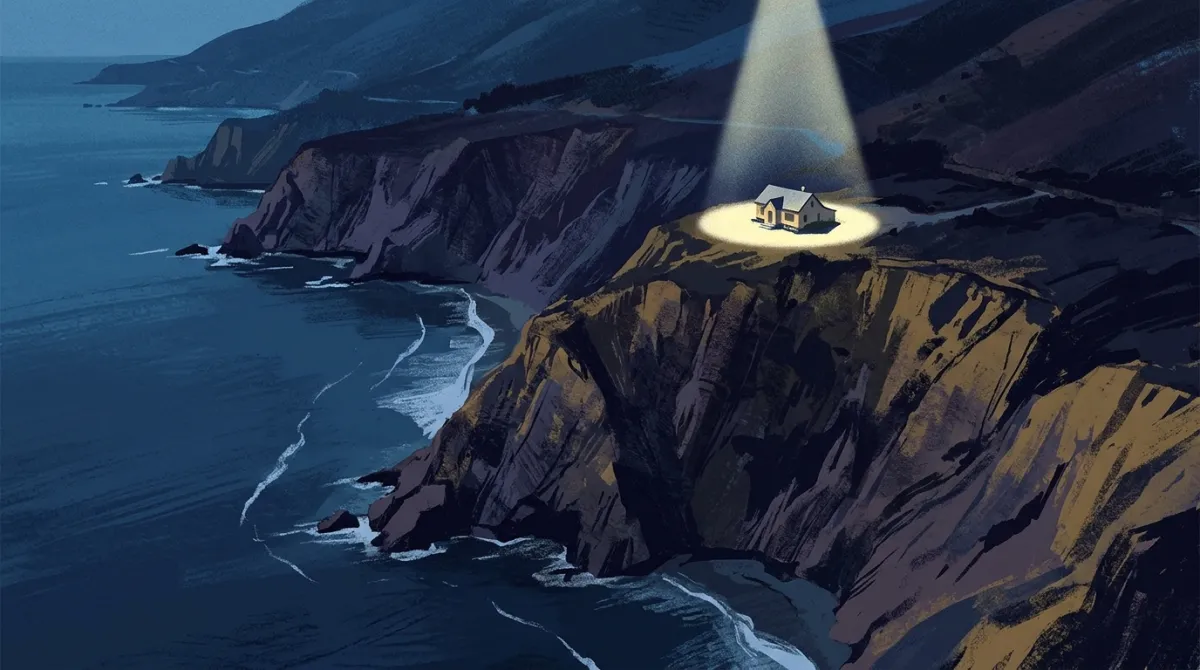
The Streisand effect is what happens when trying to hide or remove something makes far more people see it. It is named after Barbra Streisand, whose 2003 lawsuit over an aerial photo that included her Malibu home took the image from six downloads to more than 420,000 within a month. It is a real pattern, not a rule: most of the evidence for it is a list of failures, and censorship that works rarely becomes a story.
That last point is the part most explanations skip. The researchers who wrote the main academic paper on the effect spend a good share of it warning about what the term hides.
The photo that named it
The California Coastal Records Project is a public online archive of photographs of the California coastline. One of them, Image 3850, included Streisand’s home. In 2003 she sued the photographer, Kenneth Adelman, and Pictopia.com for invasion of privacy, seeking $50 million.
According to Jansen and Martin’s account, the photo had been downloaded just six times before the suit, two of them by her own lawyers. Once the lawsuit became news, it was downloaded over 420,000 times within a month. (Wikipedia’s version of the same figure counts more than 420,000 people visiting the site, so treat it as the size of the surge more than as an exact count of downloads.) The Los Angeles Superior Court dismissed the case in December 2003, and Streisand was reportedly ordered to pay $177,000 of Adelman’s legal fees.
The name came later. In January 2005 Mike Masnick, founder of the blog Techdirt, used it while writing about a resort’s takedown notice to urinal.net. Wikipedia quotes him as writing, “Let’s call it the Streisand Effect.” As Jansen and Martin put it, Streisand was “unlucky enough” to have her name attached. They also note she had reasonable concerns about privacy and safety. The backfire came from the size and publicity of the response.
Four cases, and how each one went wrong
All four appear in Jansen and Martin’s paper. They are useful because they show the effect is not only about celebrities.
| Who | What they tried | What happened |
|---|---|---|
| Bridgeport Hospital, 2002 | Sued a widower for breaching a settlement’s confidentiality clause after a newspaper quoted him | National coverage made the hospital look insensitive, and it quickly withdrew the suit |
| Streisand, 2003 | Sued for $50 million over a coastal photo | Six downloads became over 420,000, and the case was dismissed |
| Trafigura, 2009 | Got a “super-injunction” stopping the media reporting a question in the UK Parliament about alleged toxic waste dumping | Twitter users found the question overnight, and the company withdrew its gag order by midday |
| Argyll and Bute Council, 2012 | Banned nine-year-old Martha Payne from photographing school lunches for her blog | She blogged about the ban, national media picked it up, and the council reversed it |
Notice what they share. Each one turned a small, dull story into a better one: rich person versus archive, hospital versus widower, company versus Parliament, council versus child. That common thread is our reading rather than the paper’s claim, but it fits their finding that media coverage is crucial to triggering a backfire. The new story has someone to root against. It is the same reason rage bait travels, except that here nobody planned it.
The problem with every list of examples
Here is the warning that matters. Jansen and Martin write that the flaw in looking only at instances of the Streisand effect is that “there is no control group; the cases examined are potentially atypical.” And then the harder part: “The most successful efforts at censorship are little known, or not known at all.”
So nobody can give you a rate. There is no honest figure for how often suppression backfires, because the successes are, by definition, the cases you never heard about. A list of Streisand effects tells you the outcome is possible. It says nothing about how likely it is.
The paper does look at cases that held, at least for a long time:
- Lenin’s collected works. Soviet censors cut writings from the supposedly complete edition, then hid that they had done so. It stayed covered up until the archives opened after 1991.
- The CIA plots against Castro. Rumours were dismissed for about 15 years, with the people pursuing them written off as a lunatic fringe, until a 1975 Senate investigation confirmed them.
- Echelon. The surveillance system’s name was itself classified, and the authors say most of the wider public was unaware of it until Edward Snowden’s 2013 revelations.
Political scientists studying censorship reach a similar place from a different direction. Hobbs and Roberts note that most of the literature finds censorship generally decreases access to information, and that even small increases in the cost of getting information can have large effects, particularly when the censorship goes unnoticed. The default outcome is that it works. That is why a backfire makes news.
When it does backfire: what the research found
Sudden blocks teach people to get around them. In September 2014 China blocked Instagram. Using millions of individual actions by social media users, William Hobbs and Margaret Roberts showed that the block inspired millions of Chinese users to acquire virtual private networks. Those users then joined already-blocked sites like Twitter and Facebook, and despite having been apolitical, began browsing blocked political pages on Wikipedia and following activists. They call this the “gateway effect”: the tool you learned for one app opens everything else.
This is not quite the classic Streisand story, and they say so. Their mechanism does not rely on backlash or on anyone caring about the censorship. People simply wanted their app back. And they are clear about the limits: their findings “do not suggest that censorship is ineffective in general”, and gateway effects are most likely when increases in censorship are “sudden and blunt”.
Jailing a critic may not silence the audience. Jennifer Pan and Alexandra Siegel analysed over 300 million tweets plus Google search data from 2010 to 2017, looking at well-known Saudis imprisoned for online dissent. Repression deterred the imprisoned people from continuing to dissent online. It did not suppress dissent overall: their Twitter followers engaged in more of it, and the arrests drew public attention to them and their causes. It is easy to read that as a win for the dissidents. The people in the study were imprisoned, and the authors report that the crackdown worked on them.
What actually decides it
Jansen and Martin’s most useful idea is that a backfire is what is left over when the usual methods of managing outrage fail. They list five: hiding the censorship, devaluing the target, reinterpreting what happened, using official channels to give an appearance of justice, and intimidating opponents. Streisand, they argue, could launch intimidating legal action but could do little to stem the reaction once it was public.
Put together with the Instagram and Saudi studies, a few things seem to raise the odds. This list is our synthesis, not a tested model:
- The attempt itself is visible. Censorship that goes unnoticed gives nobody anything to react to.
- Someone with reach picks it up. The authors call media coverage crucial.
- The response looks out of proportion. Publicity about the $50 million demand increased outrage in Streisand’s case.
- People lose something they already use. That is the Instagram finding, and it needs no politics at all.
- Copying is cheap. The authors say the reach and speed of the web amplify the effect, though the logic is much older than the internet.
The spread itself can look a lot like context collapse, where something meant for one audience lands in front of everybody. And there is a cynical version. The authors note that publicists sometimes manufacture a backfire on purpose to drive demand for a film or book, a cousin of the made-for-attention content that dead internet theory worries about. A “banned” label is not always evidence that anyone tried very hard to ban it.
The short version
The Streisand effect is suppression that creates the attention it was meant to prevent, named after a lawsuit that turned six downloads into over 420,000. It is real and it has been measured, but the well-known examples are a selected sample of failures. Treat it as a risk worth weighing, not a law of the internet. Sometimes hiding something really does work, and you would not know.
Sources: Jansen SC, Martin B. The Streisand effect and censorship backfire. International Journal of Communication 2015;9:656-671. ijoc.org/index.php/ijoc/article/view/2498; Hobbs WR, Roberts ME. How sudden censorship can increase access to information. American Political Science Review 2018;112(3):621-636. doi:10.1017/S0003055418000084; Pan J, Siegel AA. How Saudi crackdowns fail to silence online dissent. American Political Science Review 2020;114(1):109-125. doi:10.1017/S0003055419000650; the term’s coinage, Image 3850 and the fee figure as given in Wikipedia: Streisand effect. This page explains a term and summarises published research; it does not report new research.
Frequently asked
What is the Streisand effect?
It is what happens when an attempt to hide, remove or censor something draws more attention to it than it would have received if nobody had acted. Researchers Sue Curry Jansen and Brian Martin describe it as a special outcome of censorship attempts, one in which the methods used to reduce outrage did not succeed.
Why is it called the Streisand effect?
In 2003 Barbra Streisand sued photographer Kenneth Adelman and Pictopia.com for $50 million over an aerial photo that included her Malibu home. Before the suit the photo had been downloaded six times, two of them by her lawyers. The publicity pushed it past 420,000 downloads within a month. Mike Masnick of Techdirt attached her name to the pattern in 2005.
Is the Streisand effect real?
Yes, in the sense that backfires are well documented and some have been measured. Hobbs and Roberts found that China's 2014 Instagram block led millions of users to acquire VPNs. But it is not a law. Jansen and Martin call it a contingent outcome, and Hobbs and Roberts say plainly that their findings do not suggest censorship is ineffective in general.
Why is the Streisand effect misunderstood?
Because people treat it as a rule that suppression always backfires. The evidence for that impression is a list of failures. As Jansen and Martin put it, the concept looks only at instances when censorship efforts failed, and the most successful censorship is little known or not known at all. You cannot count the stories that never got out.
What makes it more likely to happen?
The sources point to a few conditions. Jansen and Martin say media coverage is crucial to triggering backfire, and that a demand seen as excessive can increase outrage. Hobbs and Roberts find gateway effects most likely when censorship is sudden and blunt, and when people lose something they already use and cannot easily replace.
How do you avoid the Streisand effect?
Our reading, not a finding from the research: first ask how many people have actually seen the thing, because something obscure may stay obscure if you leave it alone. Then ask whether your complaint would make a better story than the original. A polite, proportionate request carries less of that risk than a large legal threat. For a real legal problem, ask a lawyer, since this page is not legal advice.
Does it only apply to celebrities?
No. Jansen and Martin's examples include a hospital that sued a grieving widower over a confidentiality agreement, and a nine-year-old Scottish schoolgirl whose school lunch blog was banned by her local council. They do note that celebrities are particularly vulnerable because they are already highly visible.