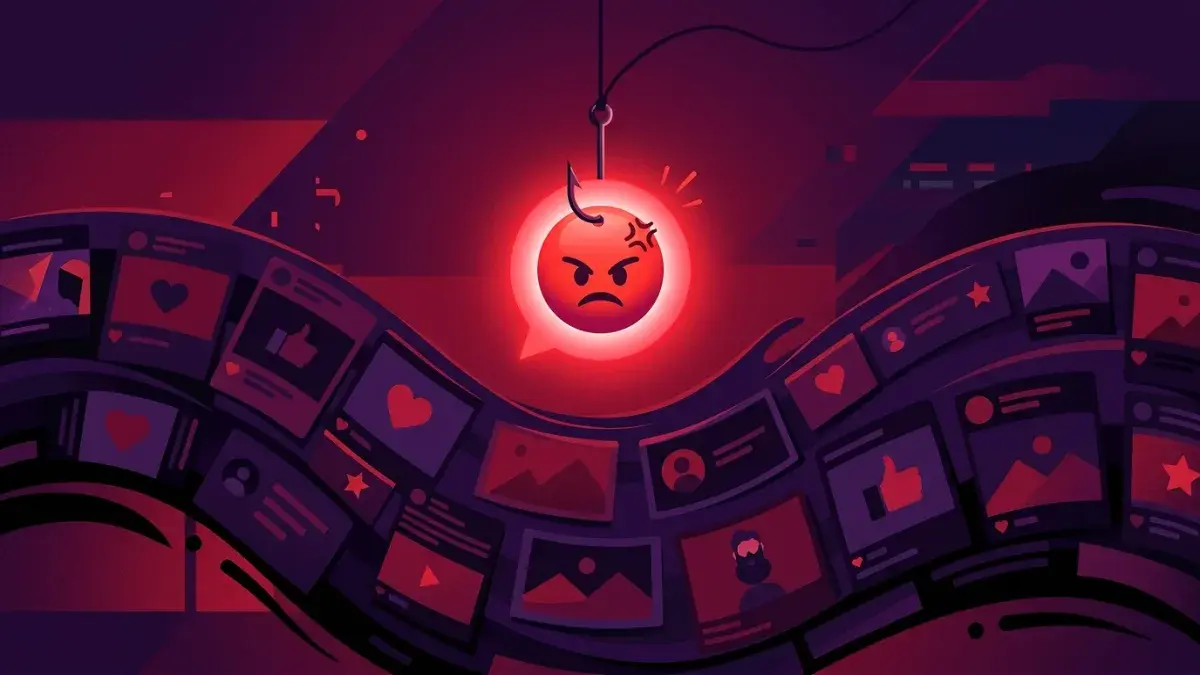
Rage bait is online content made to make you angry so that you will comment, share or keep watching. Oxford defines it as content “deliberately designed to elicit anger or outrage by being frustrating, provocative, or offensive”, posted to increase traffic or engagement. It was Oxford’s Word of the Year for 2025, and the word had tripled in usage over the previous twelve months.
What makes the term useful is the word deliberately. Plenty of things online make people angry because something angering happened. Rage bait is the case where the anger was the plan, and the post is a trap with a reaction as the prize.
Why Oxford picked it
The choice came after three days of public voting in which more than 30,000 people took part. Oxford’s own explanation is about a change in what the internet is trying to do to you. Casper Grathwohl, president of Oxford Languages, put it this way: before, the internet was grabbing attention “by sparking curiosity in exchange for clicks”, and now it is “hijacking and influencing our emotions, and how we respond”.
He also tied it to the previous year’s winner. “Brain rot” named the mental drain of endless scrolling, and rage bait names the content engineered to spark outrage and drive clicks. In his words they form a cycle in which outrage sparks engagement, algorithms amplify it, and constant exposure leaves us mentally exhausted. If you have read about doomscrolling, this is the supply side of the same loop.
Rage bait is not just clickbait
Oxford describes rage bait as a close parallel to clickbait with “a more specific focus on evoking anger, discord, and polarization”. The difference in what each one wants is worth laying out, because it changes how you should read a post.
| Clickbait | Rage bait | |
|---|---|---|
| Emotion it targets | Curiosity | Anger, indignation |
| What it needs from you | A click | A reaction: reply, quote-post, angry share |
| Does it need you to read it? | Usually yes, that is the click | Often not; the headline or a screenshot is enough |
| Disappointment when it fails | “That was nothing” | Often none, because the argument is the payoff |
The comparison table is our reading of the difference, not Oxford’s. The part that matters is the third row. A clickbait post that disappoints you has failed. A rage bait post that you argue with has succeeded.
Why anger travels: two studies
The business logic rests on two findings from 2021, both published in peer-reviewed journals.
Out-group language is what gets shared. Rathje, Van Bavel and van der Linden analysed 2,730,215 posts from news media accounts and US congressional members on Facebook and Twitter. Posts about the political out-group were shared or retweeted about twice as often as posts about the in-group, and each term referring to the out-group raised the odds of a post being shared by 67%. Out-group language was a stronger predictor of shares than negative-emotion words or moral-emotional words, by about 4.8 and 6.7 times respectively, and a very strong predictor of “angry” reactions. The authors concluded that social media may be creating “perverse incentives” for content that expresses out-group animosity.
Outrage gets rewarded, so people learn to produce it. Brady and colleagues analysed 12.7 million tweets from 7,331 users and ran two behavioural experiments with 240 participants. They found that positive social feedback for outrage expressions made people more likely to express outrage later, as reinforcement learning would predict. People also adjusted how angry they were to match their network’s norms.
Put together, these explain why rage bait is not a fringe tactic. Angry, us-versus-them content earns outsized engagement, and engagement teaches everyone who sees the scoreboard, human or not, to make more of it. The same logic of rewarding the wrong thing runs through enshittification on the platform side.
A caution on scope. Both studies are about social media in general and political or moral content in particular. Neither is a study of a thing called “rage bait”, and neither measured intent. They show that the incentive exists. The rest is inference.
How to recognise it
These are signs that come from reading a lot of these posts, not a validated test, and any one of them can show up in an honest post:
- It is built to split people. The claim is designed so that two groups will each feel attacked.
- A group is the villain in line one. The out-group effect above says this is the strongest lever.
- There is no source. No link, no date, no way to check what happened.
- It ends with a forced choice. “Which side are you on?” is a request for a comment.
- Your first impulse is to correct it. That impulse is the product.
The question underneath all five is whether the post would exist if it earned no reaction. A report of something real would. A staged situation or a deliberately provocative take often would not. It is also a close cousin of what dead internet theory worries about, where content is made for the machine’s attention rather than for a person.
What it costs you
Oxford’s framing of the cost is mental exhaustion. The simpler version is that arguing with a post built to start an argument is a trade where you spend time and temper and the poster collects the engagement. Not replying is a real option, and so is muting the account. Neither study shows that doing so changes any particular platform’s ranking, and we are not claiming that it does. It does change what you spend your evening on.
The short version
Rage bait is content where your anger is the point. Oxford named it the word of 2025 after usage tripled in a year, and two large studies from 2021 show why the incentive exists: out-group anger gets shared about twice as often, and being rewarded for outrage teaches more of it. You cannot always tell bait from a genuine report, but you can ask whether the post only works if you react.
Sources: Oxford Languages, Word of the Year 2025: rage bait, languages.oup.com/word-of-the-year/2025; Rathje S, Van Bavel JJ, van der Linden S. Out-group animosity drives engagement on social media. PNAS 2021;118(26):e2024292118. doi:10.1073/pnas.2024292118; Brady WJ, McLoughlin K, Doan TN, Crockett MJ. How social learning amplifies moral outrage expression in online social networks. Science Advances 2021;7(33). doi:10.1126/sciadv.abe5641. This page explains a term and summarises published research; it does not report new research.
Frequently asked
What is rage bait?
Oxford defines it as online content deliberately designed to elicit anger or outrage by being frustrating, provocative or offensive, typically posted to increase traffic to or engagement with a page or account. The key word is deliberately: the anger is the product, and the post exists to harvest the reaction.
What is the difference between rage bait and clickbait?
Oxford calls them close parallels, with rage bait focused more specifically on evoking anger, discord and polarisation. Clickbait promises you something to get a click, and the click is the end of it. Rage bait wants a reaction, and a comment, quote-post or angry share counts as a payout whether or not you ever read the thing.
Why was rage bait Word of the Year 2025?
Oxford's experts chose it after three days of public voting in which more than 30,000 people took part, and said its usage had tripled in the previous twelve months. Oxford Languages' president linked it to the previous year's choice, brain rot: outrage sparks engagement, algorithms amplify it, and constant exposure leaves people mentally exhausted.
Why does rage bait work?
Two findings help. A 2021 study of 2.7 million posts found that posts about the political out-group were shared about twice as often as posts about the in-group. And a separate 2021 study found that positive social feedback for outrage makes people express more of it later, in the way reinforcement learning predicts. Anger gets rewarded, so more of it gets made.
Does replying to a rage bait post make it worse?
In engagement terms, yes. The studies measured shares, retweets and reactions, and an angry reply or quote-post is still a signal of attention. Neither study tested what a given platform's ranking does with replies, so treat this as the logical consequence of rewarded outrage, not a measured effect of one specific action.
Is all outrage rage bait?
No. Outrage about something that actually happened is a reaction to news. Rage bait is made for the reaction. A useful test is whether the post would still exist if it earned no engagement: a report of a real event would, while a deliberately provocative take or staged situation often would not.
How can you spot rage bait?
Look for a claim built to split people, a missing source, a target group named in the first line, and a closing question that asks you to pick a side. None of these proves bad faith alone, and they are signs from reading these posts, not a validated detector. If your first impulse is to reply with a correction, that impulse is what the post was built to produce.