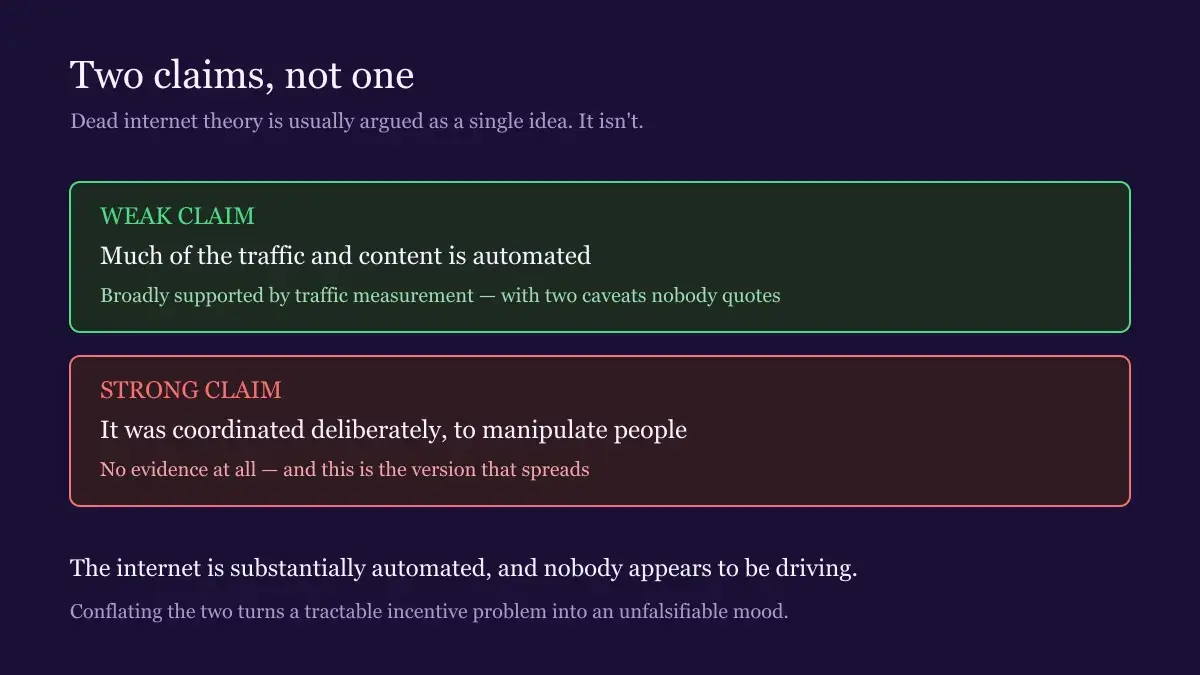
Dead internet theory is the claim that most of what you encounter online is no longer made by people. It contains two separate assertions that are almost always run together: that the internet is largely automated, and that this was done on purpose. The first is broadly supported. The second has no evidence behind it at all.
Where it came from
From anonymous forums around 2020 and 2021, most influentially a long post titled Dead Internet Theory: Most Of The Internet Is Fake, which argued that the web had been quietly emptied of people some years earlier and that what remained was mostly machines talking to machines.
It began as folklore, not research — closer to a campfire story than an analysis. Its evidence was impressionistic: forums that felt repetitive, comment sections that felt scripted, the same handful of opinions recurring in slightly different words. That origin matters, because the theory was not derived from measurement. Measurement arrived later and matched parts of it, which is a stranger and more interesting situation than either being right or being wrong.
The two claims, separated
| Claim | Evidence |
|---|---|
| Weak: much of the traffic and content is automated | Broadly supported by traffic measurement, with caveats below |
| Strong: it was coordinated deliberately, to manipulate people | None |
What the bot numbers actually measure
Firms that sit in front of large volumes of web traffic have for several years reported automated traffic at roughly half of all requests. That figure is real and it is the usual basis for saying the theory came true.
Two caveats are essential, and they are almost always dropped:
These are not samples of the internet. They measure traffic to the sites those vendors protect, which over-represents sites worth attacking. It is a measurement of a defended subset, presented as a measurement of everything.
“Bot” includes infrastructure. Search crawlers, uptime monitors, price checkers, archive scrapers. A number near half is accurate; reading it as “half the people are fake” is not what was counted.
What generative AI actually changed
It made the content half cheap — and the content half was the theory’s weakest point when it was written. In 2021, mass-producing plausible human-sounding posts needed either people or visibly templated text. “The comments are fake” was the claim you could most easily disprove by reading them.
That constraint is gone. The result is genuinely odd: a piece of internet folklore written before the tools existed described a condition the tools then made achievable. That is not the same as having been right — it also claimed coordination, and nothing has appeared to support that. See how much of what you read is AI-generated for the content side.
Why the distinction is worth keeping
Because the two versions imply completely different responses.
If the web is automated because generating content became nearly free while engagement is rewarded regardless of origin, then this is an incentive problem, and incentive problems have structural fixes: provenance signals, ranking that discounts volume, spaces with some cost to entry.
If instead it is a coordinated deception, none of that helps and the only rational response is to distrust everything. That version is more dramatic, it is the one that travels, and it is the one with nothing behind it. Conflating them converts a tractable design problem into an unfalsifiable mood.
The honest summary
The internet is substantially automated, and nobody appears to be driving. Those are both unsettling, and only one of them is the thing the theory is famous for.
Note on sourcing: the bot-traffic figures described here are the range consistently reported across annual industry reports rather than a single study, and the caveats about what they sample apply to all of them. Where this piece says a claim has no evidence, that means no evidence has been published — not that it has been disproved.
Frequently asked
What is dead internet theory?
The claim that most of what you encounter online is no longer produced by people — that bots generate the traffic, the posts and the replies, and that human activity is now a minority of the web. It circulated on internet forums from around 2021 and has two versions that are usually run together. The weak version says the internet is largely automated. The strong version says this happened deliberately, coordinated by governments or platforms to manipulate what people believe. Those two claims need to be assessed separately, because the evidence for them is not remotely comparable.
Is dead internet theory true?
Partly, and specifically the half that was never the interesting part. Security vendors that measure web traffic consistently report that automated traffic accounts for something close to half of all requests, and the arrival of generative text and image tools has made the content side of the claim far more plausible than it was when the theory was written. What has no supporting evidence is the coordination claim — that any actor planned or directs this. The honest summary is that the internet is substantially automated and that nobody appears to be driving.
Where did dead internet theory come from?
From anonymous internet forums around 2020 and 2021, most influentially a long post titled 'Dead Internet Theory: Most Of The Internet Is Fake', which argued that the web had been quietly emptied of people some years earlier. It began as folklore rather than research — closer to a creepypasta than an analysis — and its early evidence was impressionistic: forums that felt repetitive, comment sections that felt scripted, the sense that the same opinions kept recurring in slightly different words. That origin matters when weighing it, because the theory was not derived from measurement. Measurement arrived afterwards and matched parts of it.
How much internet traffic is actually bots?
Reports from firms that sit in front of large volumes of web traffic have for several years put automated traffic at roughly half, with the split between benign automation and malicious bots varying by year and by report. Two caveats are essential and usually dropped. First, these figures measure traffic to the sites those vendors protect, which over-represents sites worth attacking and is not a random sample of the internet. Second, 'bot' includes search-engine crawlers, uptime monitors and price checkers — infrastructure, not deception. A number near half is real; reading it as 'half of the people are fake' is not what it measures.
Did AI make dead internet theory true?
It made the content half of it cheap, which is the part the original theory could not explain. When the theory was written, mass-producing plausible human-sounding text required either people or obvious templates, so 'the posts are fake' was the least credible claim in it. Generative tools removed that constraint. The odd result is that a conspiracy theory written before the technology existed described a condition the technology then made attainable — which is not the same as the theory having been right, because it also claimed coordination, and that part remains unsupported.
Why does the difference between the two versions matter?
Because they imply completely different responses. If the internet is automated because generating content became nearly free and engagement is rewarded regardless of origin, the problem is one of incentives, and the fixes are structural: provenance, ranking that discounts volume, spaces with a cost to entry. If instead it is a coordinated deception, none of that helps and the only response is to distrust everything. The second framing is more dramatic, is the one that spreads, and is the one with no evidence behind it. Conflating them turns a tractable design problem into an unfalsifiable mood.
Is the internet getting worse, or just more automated?
They are different processes and both are happening. Platform decay describes quality declining because a platform's incentives shift away from its users over time — a sequence with a mechanism behind it. Automation describes who or what is producing the material. A platform can decay with entirely human content, and a heavily automated platform can be perfectly useful, as search engines demonstrated for two decades. Keeping the two apart is what makes either of them possible to reason about.