What is The AI Power Wall: Why $725 Billion in Capex Can't Buy Enough Electricity (July 2026)?
The AI story of 2026 was supposed to be about models. It has turned out to be about megawatts. The four largest US hyperscalers - Google, Amazon, Microsoft, and Meta - are now guiding toward roughly $725 billion in combined capital expenditure this year, up about 77% from last year's $410 billion. Fold in Oracle, the neoclouds, and the sovereign funds, and 2026 becomes the first year total compute capex clears a trillion dollars. Yet the binding constraint is no longer capital, and it is no longer even chips. It is electricity.
Announced is not energized
The number that actually defines this cycle is not the capex figure. It is the gap between what got announced and what turns on. Analysts tracking US buildouts count roughly 12 gigawatts of 2026 data center capacity announced across about 140 projects, but only around 5 gigawatts under active construction. That leaves a shortfall near 7 gigawatts, much of it with no disclosed plan for power at all. The industry has coined a phrase for the gap: announced is not energized.
Microsoft made the abstraction concrete. The company has said it is sitting on something like $80 billion in Azure orders it cannot fill, because the electricity to run the servers is not there. That is not a demand problem and not a GPU-allocation problem. It is a wires-and-transformers problem, and wires and transformers run on a different clock than software.
The five-year transformer
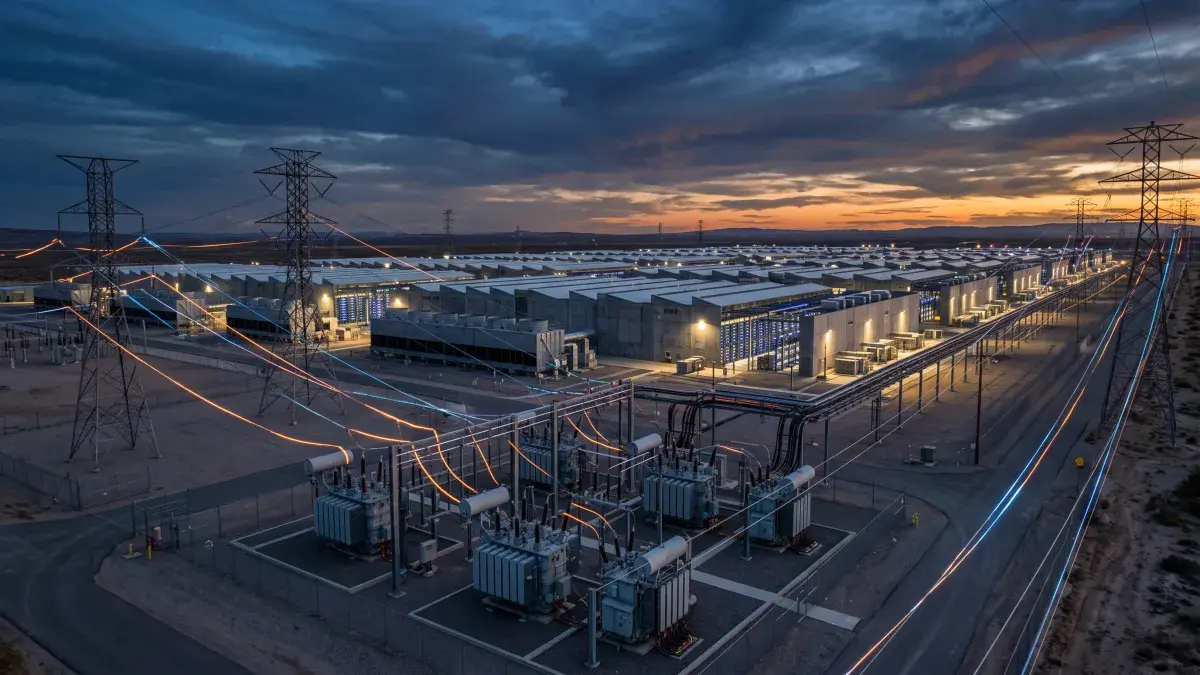
Here is the detail that should reframe every AI infrastructure timeline you have read this year. Lead times on the high-voltage transformers and switchgear that connect a data center to the grid now stretch toward five years. You cannot write a bigger check to skip the queue, because the bottleneck is a global manufacturing backlog, not a budget line. The World Economic Forum now calls grid connectivity the strategic bottleneck of the entire AI transition, and US utilities have responded by penciling in more than $1.4 trillion of capital plans through 2030.
The physics is unforgiving. Anthropic has estimated that by 2027, training a single frontier model will demand about five gigawatts of continuous power, roughly the output of five nuclear reactors, and that the US AI sector alone will need on the order of 50 gigawatts of new capacity by 2028 to stay competitive. Compute for frontier training has been doubling every five to six months. Grid capacity does not double on anything close to that schedule, which is the whole problem in one sentence.
The market is starting to notice the gap
Investors are no longer clapping reflexively at big capex numbers. The concern now is the widening distance between AI spending and AI revenue: depreciation and operating costs are ramping faster than the top line they are meant to produce, and public markets have begun to reprice the names most exposed to it. That repricing is bleeding into how people think about the AI-heavy index funds that quietly became a huge share of ordinary portfolios over the past two years. When four companies account for a trillion dollars of spend, their power problem is everyone's portfolio problem.
This also reframes the funding story we have been tracking. The AI funding supercycle poured capital into models and the labs building them. The open-weight squeeze then compressed the price of intelligence itself. Both stories assumed that if you had the money and the chips, you could scale. The power wall says otherwise: past a certain size, the scarce input is not talent, capital, or silicon. It is a substation.
The practical takeaway
If you run infrastructure, procurement, or strategy at a company that consumes AI at scale, the discipline for 2026 is to treat power availability as a first-class variable in every AI roadmap. Three concrete moves follow from that. First, when a vendor promises capacity by a given quarter, ask whether the site is energized or merely announced, and ask what the interconnection date is; those are different questions with different risk profiles. Second, price in the possibility that inference capacity, not model quality, becomes the thing you have to queue for, and negotiate committed capacity accordingly. Third, if you are already thinking about governing fleets of AI agents in production, remember that every autonomous agent you deploy is a standing power draw, not a one-off query, and plan the unit economics around electrons rather than tokens.
The bottleneck moved. The companies that win the next 18 months will be the ones that noticed power became the constraint before their competitors did, and built their timelines around the grid instead of around the GPU.
Origin
As 2026 hyperscaler earnings and guidance pushed combined AI capital expenditure toward $725 billion, analysts noticed that far less announced data center capacity was actually energized than planned, exposing electricity and grid infrastructure - not GPUs or capital - as the real bottleneck on AI scaling.
Timeline
Why Is This Trending Now?
Combined Big Tech AI capex is guiding to ~$725 billion in 2026, up ~77% year over year, yet only about 5 of ~12 announced gigawatts of US data center capacity is under construction, and Microsoft says it cannot fill ~$80 billion in Azure orders for lack of power. The 'power wall' has become the defining strategic story of the AI buildout.
Frequently Asked Questions
Sources
- Tom's Hardware - Big Tech AI spending plans reach $725 billion
- The Forward View - Announced Is Not Energized: AI Capex Hits the Power Wall
- World Economic Forum - Is power grid connectivity the strategic bottleneck for AI?
- Forbes - The AI Capex-to-Revenue Gap Is Widening
- CNBC - Tech AI spending approaches $700 billion in 2026