What is AI's 2026 Funding Supercycle and the Frontier-Model Parity Moment, Explained (June 2026)?
For three years the dominant question in artificial intelligence was simple and singular: which model is best? In the summer of 2026 that question quietly stopped mattering. For the first time, several frontier models from different labs now sit at near parity on price and quality - close enough that for most real workloads the differences are a rounding error. The interesting question has flipped from "which model is best?" to "which model is best for this workflow at this price?" And the whole shift is being underwritten by the largest private capital raises in the history of venture investing.
The numbers behind the supercycle
The capital flowing into frontier AI in 2025-2026 has no precedent. OpenAI closed $122 billion in committed capital at an $852 billion post-money valuation in late March 2026 - the largest private financing deal in Silicon Valley history, led by a $50 billion Amazon commitment with Nvidia and SoftBank each adding roughly $30 billion. Weeks earlier, Anthropic raised a $30 billion Series G at a $380 billion post-money valuation, the second-largest venture deal of all time. We covered that round as it broke in our explainer on Anthropic's funding and the road to a $900B valuation.
It is not a two-horse race. In Europe, Mistral AI raised a 1.7 billion-euro Series C at an 11.7 billion-euro valuation led by chip-equipment giant ASML, and is reportedly already chasing a far larger round. In voice, ElevenLabs raised a $500 million Series D at an $11 billion valuation led by Sequoia. The pattern is the same everywhere: enormous checks, written fast, at valuations that assume the winners will earn their keep.
What the parity moment actually means for buyers
For most of the last cycle, picking a model was a status decision - you bought the leaderboard champion and paid the premium. That logic is now broken. When two or three frontier models cluster within a few points on the benchmarks that matter to you, the smart move is to stop optimizing for raw capability and start optimizing for fit: latency, context window, tool-calling reliability, the price per million tokens at your actual volume, and how the model behaves inside your specific stack.
This is why the buying conversation has moved from the demo to the invoice. A coding agent running thousands of calls a day has completely different economics than a customer-support summarizer or a once-a-day research digest. The same model that is a bargain for one is a waste for the other. If you are evaluating tools rather than building them, our running guide to practical AI skills and tooling is a better starting point than any single benchmark.
Why the capital is flowing this hard
The bull case is that revenue is finally catching up to the hype. Anthropic reported run-rate revenue around $14 billion and Claude Code alone past $2.5 billion in run-rate, with enterprise now more than half of that. The adoption data backs it up: roughly 79% of enterprises say they have adopted AI agents in some form, and Anthropic alone now serves 8 of the Fortune 10 and around 70% of the Fortune 100. When the largest companies on earth are standardizing on your product, multibillion-dollar rounds start to look less like speculation and more like infrastructure financing. We dug into the enterprise side in our piece on AI agents reshaping knowledge work.
The risk: can the valuations be earned?
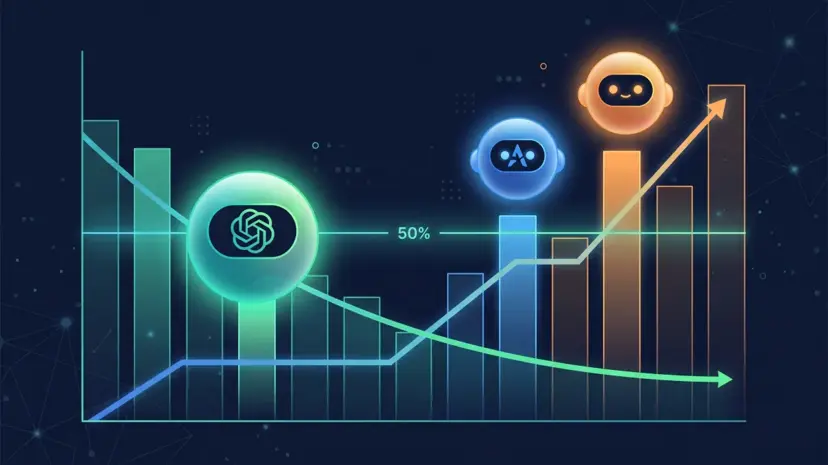
Here is the uncomfortable part. The same enterprise survey that shows 79% adoption also shows only about 11% of enterprises running agents in production - the largest deployment backlog in enterprise technology history. OpenAI is still burning cash, and a large slice of Amazon's commitment is reportedly contingent on a future IPO or an AGI milestone. Parity itself is a threat to the economics: when models are interchangeable, pricing power erodes and margins compress toward the cost of compute. A $380 billion or $852 billion valuation assumes the lab keeps either a capability lead or a distribution moat. Parity attacks the first; commoditized cloud access attacks the second. The market's move below 50% share for the former leader, which we covered in ChatGPT dropping below 50% market share, is exactly the kind of erosion these valuations cannot afford to repeat across every product line.
How to choose a model per workflow
The practical takeaway for any team is to stop shopping for a single "best" model and start treating model choice as a per-workflow routing decision. A simple framework:
- Map the workflow first. Volume, latency tolerance, context size, and how much tool-calling or structured output it needs. The workflow dictates the model, not the other way around.
- Score on fit, not leaderboard rank. For most production tasks, three frontier models will all clear the bar - pick the cheapest that does so reliably.
- Route, do not marry. Use a cheaper model for high-volume, low-stakes calls and reserve the premium model for the small share of hard cases. Parity makes multi-model routing the default architecture, not an edge optimization.
- Re-evaluate quarterly. At this funding pace, price and capability shift every few months. A model choice that was optimal in Q1 may be overpriced by Q3.
The funding supercycle and the parity moment are two sides of the same coin. Investors are betting tens of billions that these labs become permanent infrastructure; buyers, meanwhile, are quietly discovering that the infrastructure is now plural - and that the winning strategy is no longer loyalty to one model, but fluency across several.
Origin
The convergence of three record-breaking funding rounds (OpenAI's $122B, Anthropic's $30B Series G, Mistral's 1.7B-euro Series C) in early 2026, alongside benchmarks showing frontier models clustering at near parity, reframed the entire AI buying conversation.
Timeline
Why Is This Trending Now?
Investors are committing tens of billions at valuations up to $852B while frontier models become increasingly interchangeable - forcing buyers, founders and finance watchers to reassess what these valuations actually depend on. It's prime LinkedIn debate fodder for developers, AI builders and investors.