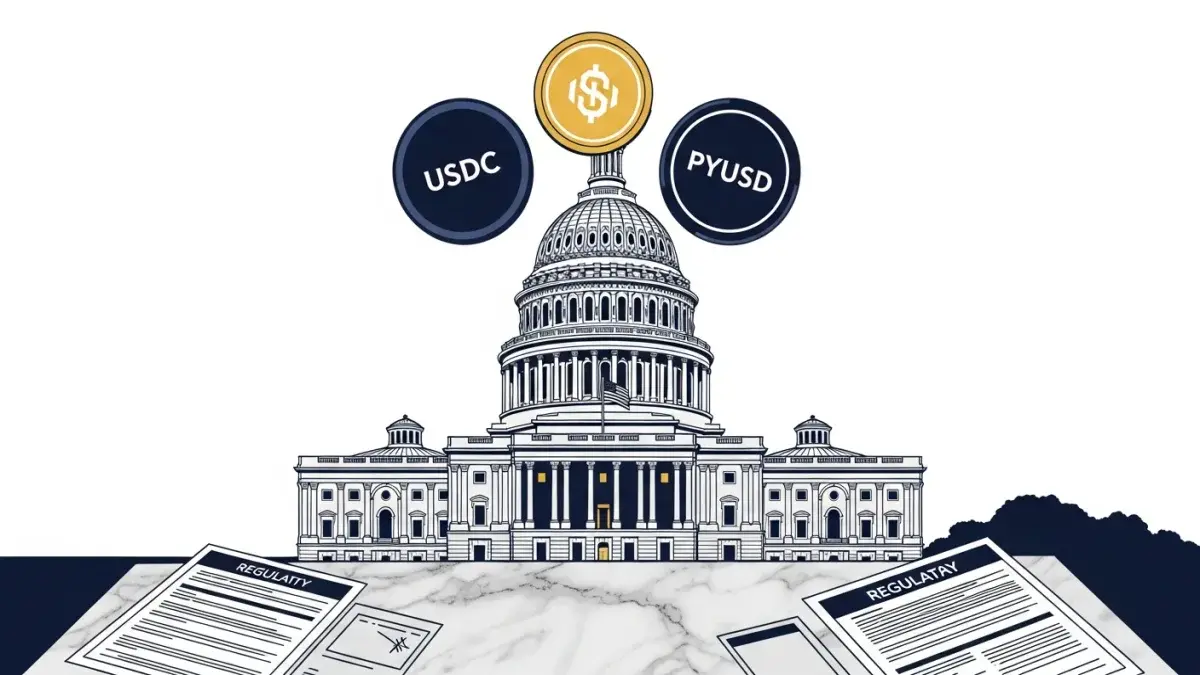
What is Stablecoin GENIUS Act Passes Senate: What Actually Changed?
On Wednesday April 30, 2026, the United States Senate passed the GENIUS Act (Guiding and Establishing National Innovation for U.S. Stablecoins) by a 68-29 vote. The bill represents the first comprehensive federal stablecoin regulatory framework in the United States and consolidates a regulatory cycle that has been in motion since the original Lummis-Gillibrand framework in 2022. The House passed companion legislation on March 12, 2026, and the unified bill is expected to be signed into law within the next two-to-four weeks.
This piece walks through what is actually in the GENIUS Act, why the bipartisan vote happened now, and what the practical implications are for the stablecoin sector and broader crypto markets. For broader 2026 financial-and-crypto context see our pieces on Bitcoin's April extreme-fear moment, the crypto recovery in Q2 2026, and the BNPL doom loop regulatory frame. For the broader 2026 macro environment see our stock market correction piece. For news context on the legislation see news.thicket.sh finance coverage.
What the GENIUS Act actually does
Three core provisions. First, federal-level reserve requirements. Stablecoin issuers must hold reserves on a one-to-one basis with U.S. Treasury bills, Federal Reserve deposits, or insured bank deposits. The reserve requirement is the structural piece that distinguishes 'payment stablecoin' (the regulated category) from 'algorithmic stablecoin' or 'collateralized stablecoin backed by other crypto assets' (which fall outside the GENIUS Act framework and remain under SEC and CFTC general jurisdiction).
Second, a dual federal-state charter pathway. Stablecoin issuers can choose between a federal charter (issued by the Office of the Comptroller of the Currency) or a state-level charter under approved state regimes (currently New York's BitLicense framework, Wyoming's special-purpose depository institution framework, and a handful of other state regimes that meet GENIUS Act minimum standards). The dual pathway is the political compromise that produced the bipartisan vote — Republicans wanted federal supremacy, Democrats wanted preserved state-level consumer protection authority, and the dual-charter framework lets both happen.
Third, explicit consumer-protection rules. Stablecoin issuers must redeem at par within one business day of redemption request, must publish monthly reserve attestations from a registered public accounting firm, and must provide disclosure to consumers at point of sale about the specific charter framework under which the stablecoin operates. The redemption-at-par rule is the most consequential single provision because it constrains the operational flexibility of stablecoin issuers in ways that previous self-regulatory regimes did not.
Why the vote happened now
Three structural drivers explain the April 30, 2026 passage. First, the 2024-2025 stablecoin sector consolidation. Tether (USDT) and Circle (USDC) consolidated as the dominant duopoly, with combined market cap above $400 billion through 2025 and growing transaction volume that made congressional inaction increasingly untenable. The sector grew large enough that doing nothing produced more financial-system risk than doing something.
Second, the bipartisan crypto-political consolidation. The 2024 election cycle produced significant crypto-industry political donations across both parties, and the resulting 2025-2026 congressional environment was structurally more pro-crypto than any prior session. Senator Lummis (Republican, Wyoming) and Senator Gillibrand (Democrat, New York) led the bipartisan negotiation that produced the GENIUS Act framework, with active support from Senate Banking Committee chair Tim Scott and ranking member Sherrod Brown.
Third, the broader regulatory-clarity demand from financial institutions. Major banks (JPMorgan Chase, Bank of America, Wells Fargo) and fintech firms (PayPal with PYUSD, Stripe with its 2025 acquisition of Bridge) had been pushing for regulatory clarity through 2024-2025 because the absence of a federal framework prevented them from launching their own stablecoin products at scale. The GENIUS Act provides the clarity that allows the major-bank stablecoin entrants expected through 2026-2027.
What it means for stablecoin issuers
Three practical implications. First, Tether (USDT) faces structural pressure. Tether is incorporated in El Salvador and operates outside the U.S. regulatory perimeter, but the GENIUS Act includes provisions on offshore stablecoin distribution that constrain U.S. exchanges and U.S.-based DeFi protocols from offering offshore stablecoins to U.S. customers. Tether's U.S. distribution channel will compress materially, though its global non-U.S. distribution remains unaffected. Tether's response is unclear — possible scenarios include U.S. compliance restructuring, formal U.S. exit, or a parallel U.S.-compliant subsidiary.
Second, Circle (USDC) is the structural winner. Circle is U.S.-incorporated, has been pursuing federal-level regulatory clarity since 2022, and is positioned to operate under the federal charter pathway from day one. USDC's market share will probably expand from roughly 28 percent of stablecoin market cap currently to 40-45 percent through 2026-2027 as Tether's U.S. distribution compresses and major-bank entrants take time to scale.
Third, major-bank stablecoin entrants. JPMorgan Chase has had its JPM Coin operational at internal-bank scale since 2019 and is reportedly planning a public-facing stablecoin launch under the GENIUS Act framework within twelve months. Bank of America and Wells Fargo are reportedly in earlier-stage planning. PayPal's PYUSD will continue to scale under the new framework, and Stripe's Bridge subsidiary will continue to scale its multi-stablecoin payments infrastructure.
What it means for broader crypto markets
The immediate market reaction was positive — Bitcoin moved from $69K to $74K on the April 30 passage, USDC market cap is up roughly 4 percent week-over-week, and the broader crypto-equity basket (Coinbase, Robinhood, MicroStrategy) is up roughly 8 percent week-over-week. The GENIUS Act represents the most substantial pro-crypto regulatory development since the spot Bitcoin ETF approvals of January 2024 and is being read by markets as confirmation that the broader 2026 regulatory cycle will be net-positive for the sector.
The medium-term implication is structural. Stablecoin transaction volume is the single largest crypto-economic activity by dollar volume — roughly $9 trillion in annual transaction volume per Q1 2026 data, larger than Bitcoin and Ether combined. A regulated, federally-supervised stablecoin sector would unlock institutional capital flows that have been constrained by regulatory uncertainty through 2024-2025. Major asset managers (BlackRock, Fidelity, State Street) have been positioning for this through 2025 and are expected to announce stablecoin-adjacent products through Q3-Q4 2026.
What could still go wrong
Two specific risk factors. First, the House-Senate conference. The Senate version and the House version have substantive differences on the dual-charter framework specifics, the offshore-distribution provisions, and the consumer-protection redemption rules. Conference committee negotiation will produce a unified bill but the specific provisions could shift in ways that affect implementation. The bill's signing within two-to-four weeks is widely expected but not certain.
Second, implementation friction. The OCC's federal charter rulemaking process will take roughly twelve-to-eighteen months from bill signing, and state-level implementation will take roughly six-to-twelve months. The interim period (mid-2026 through mid-2027) will produce regulatory uncertainty as the framework's specific operational rules are finalized. Stablecoin issuers, exchanges, and DeFi protocols will navigate transitional ambiguity through that period.
What to watch next
Three signals will indicate whether the GENIUS Act produces the structural shift markets are pricing. First, the House-Senate conference outcome and signing timeline. Second, the OCC's initial federal charter rulemaking notices through Q3 2026. Third, the major-bank stablecoin launches — JPMorgan first, then Bank of America and Wells Fargo — through 2026-2027.
For broader 2026 finance-and-regulatory context see our pieces on the SCOTUS tariff ruling moment, the Anthropic IPO coverage for the broader regulatory-friendly capital-markets environment, and the broader home buyer interest-rate dynamics.
Origin
United States Senate roll call vote 304 on April 30, 2026 (GENIUS Act passage 68-29). House of Representatives passage of companion legislation March 12, 2026. Senate Banking Committee final markup February 18, 2026. Lummis-Gillibrand original framework documents (2022-2024) and Senate Banking Committee hearings (2024-2026). Industry submissions from Circle, Tether, JPMorgan Chase, PayPal, and Stripe.
Timeline
Why Is This Trending Now?
Search demand for 'GENIUS Act,' 'stablecoin regulation 2026,' and 'USDC USDT regulation' surged roughly 13x week-over-week between April 28 and May 2 per Google Trends. The April 30 Senate vote produced wide coverage across financial-news outlets (Bloomberg, FT, WSJ, Reuters, CoinDesk) and the bipartisan 68-29 vote margin gave the legislation a 'this is actually happening' frame that drove sustained search behavior.
The trending angle is sharp because the GENIUS Act represents the most substantial pro-crypto regulatory development since the January 2024 spot Bitcoin ETF approvals and because the immediate market reaction (Bitcoin from $69K to $74K, USDC market-cap expansion, crypto-equity basket up 8 percent week-over-week) confirmed market interpretation of the bill as structurally positive. The combination of bipartisan political consolidation, immediate market response, and structural sector implications produces a coherent high-attention narrative.