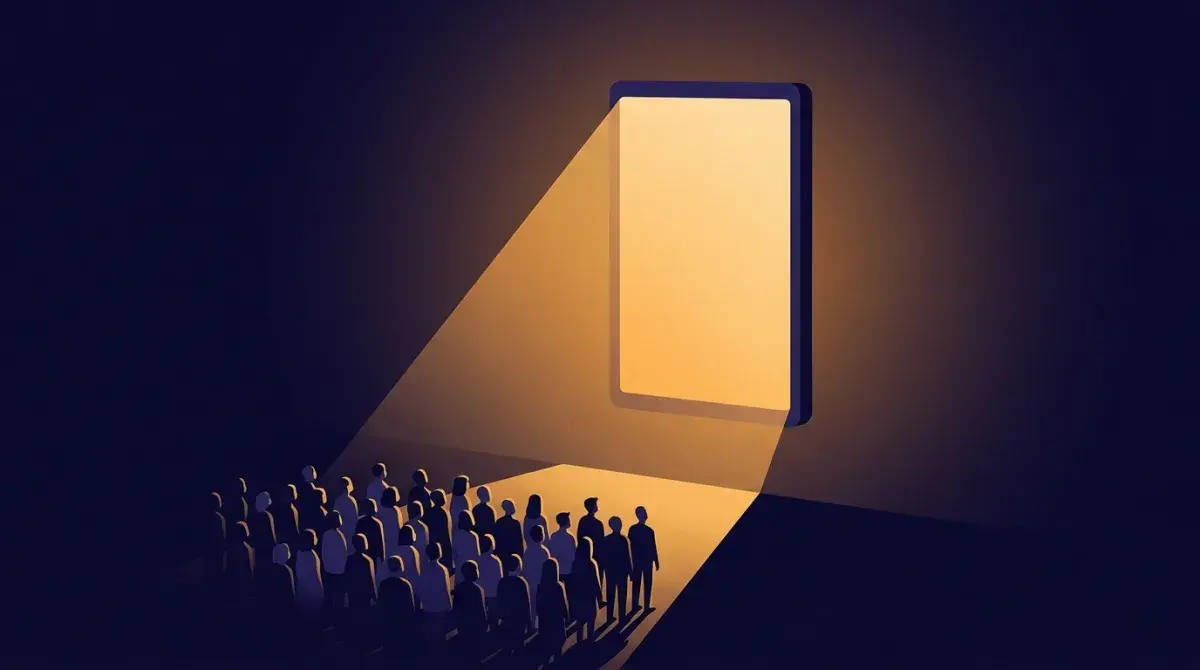
A parasocial relationship is a nonreciprocal socio-emotional connection with a media figure — a celebrity, streamer, podcaster or influencer. You know a great deal about them and feel real warmth toward them; they do not know you exist. The defining feature is asymmetry, not intensity. By that definition almost everyone has them, and having them is not a symptom of anything.
The word has drifted into an accusation — a way of telling someone they are too invested. That is not what it means, and the gap between the popular usage and the research is unusually wide.
It was defined in 1956, about television
The term comes from a 1956 paper in the journal Psychiatry by Donald Horton and R. Richard Wohl: “Mass communication and para-social interaction; observations on intimacy at a distance.”
That subtitle is the entire concept in three words. Intimacy at a distance — written about broadcast presenters, seventy years ago, decades before anyone could reply to anyone.
This matters more than a footnote. Most writing on the topic treats parasocial connection as something the internet produced, and then reasons from there to conclusions about screens and modern life. The phenomenon is older than the technology usually blamed for it.
What the evidence actually says
The most useful recent summary is a 2022 review in Current Opinion in Psychology by Hoffner and Bond, covering parasocial relationships, social media and well-being. Its conclusion is not the one the popular framing predicts.
| Documented benefits | Documented risk |
|---|---|
| Promoting healthy attitudes and behaviours | Negative self-comparison — the one adverse mental-health route the review names |
| Lowering health-related stigma | |
| Enhancing feelings of connection and community | |
| Facilitating coping; fostering personal development and identity exploration | |
| Reducing prejudice, through parasocial contact |
The reviewers describe the overall picture as showing both promise and challenges, and note that work on how the specific features of social media shape these outcomes is just beginning. That is a genuinely open question being reported as an open question.
The risk is comparison, not asymmetry
This is the most practically useful thing in the literature and the part that gets lost. The harm route the evidence identifies is negative self-comparison — measuring your life against a curated feed and coming off worse.
It is not one-sidedness. Feeling close to someone who does not know you is the ordinary condition of consuming media and has been since radio. So the useful question is not “is this relationship reciprocal?” — it is not, and that is fine — but “does time spent with this person’s output leave me feeling better or worse about my own life?” That question has an answer you can actually check.
Parasocial contact: the finding that cuts the other way
Among the benefits the review lists is reducing prejudice through parasocial contact — the idea that encountering members of a group through media can shift attitudes somewhat as meeting them in person does. It has been studied directly, including work in the Journal of Homosexuality on how parasocial interaction in digital media interacts with real social contact with LGBT people.
Whatever else parasocial connection does, this strand makes it hard to describe as simply a deficit.
Three things people mean by one word
| Term | What it is |
|---|---|
| Parasocial relationship | The ordinary, near-universal experience of feeling connected to a media figure. Descriptive, not a judgement. |
| Fandom | A social structure around shared interest — often genuinely reciprocal between fans, even when not with the figure. |
| Obsessive attachment | A distinct clinical concern with its own literature and its own thresholds. |
Collapsing all three into “parasocial” is how a neutral descriptive term became an insult.
What has genuinely changed since 1956
Not the existence of the phenomenon — the density of it. Streaming, comments, direct messages and daily posting make the intimacy far thicker and the asymmetry much easier to forget.
And one thing has changed structurally: media figures now sometimes do respond — occasionally, selectively, to a few people out of many. That blurs the nonreciprocal line the 1956 definition drew cleanly, and it is the genuinely novel part. The research on it, by the reviewers’ own description, is just beginning.
Sources
- Horton D, Wohl RR. “Mass communication and para-social interaction; observations on intimacy at a distance.” Psychiatry, 1956;19(3):215–29. PMID 13359569 — the origin of the term.
- Hoffner CA, Bond BJ. “Parasocial relationships, social media, & well-being.” Current Opinion in Psychology, 2022;45:101306. PMID 35219157 — the definition used here and every benefit and risk listed above.
- “Coevolution between Parasocial Interaction in Digital Media and Social Contact with LGBT People.” Journal of Homosexuality, 2021. PMID 32845235 — parasocial contact studied directly.
General information, not psychological advice. Every claim above was read from the cited record on 10 August 2026.
Frequently asked questions
What is a parasocial relationship?
A parasocial relationship is a nonreciprocal socio-emotional connection with a media figure — a celebrity, a streamer, a podcaster, an influencer. You know a great deal about them and feel genuine warmth toward them; they do not know you exist. The defining feature is not intensity but asymmetry. The 2022 review in Current Opinion in Psychology defines them exactly that way: nonreciprocal socio-emotional connections with media figures such as celebrities or influencers (PMID 35219157). By that definition almost everyone has them, and having them is not itself a symptom of anything.
Where does the term parasocial come from?
From a 1956 paper in the journal Psychiatry by Donald Horton and R. Richard Wohl, titled "Mass communication and para-social interaction; observations on intimacy at a distance" (Psychiatry, 1956;19(3):215–29, PMID 13359569). The phrase in that subtitle — intimacy at a distance — is the whole idea in three words, and it was written about television and radio presenters seventy years ago. The concept substantially predates social media, which matters, because most popular writing treats it as something the internet invented.
Are parasocial relationships unhealthy?
The evidence does not support a simple verdict, and the popular framing of parasocial as a diagnosis is not what the research says. The 2022 Current Opinion in Psychology review concludes that social media parasocial relationships can beneficially influence multiple dimensions of well-being while adverse outcomes may also occur, and that the growing evidence indicates both promise and challenges. Documented benefits include promoting healthy attitudes and behaviours, lowering health-related stigma, enhancing feelings of connection and community, facilitating coping, fostering personal development and identity exploration, and reducing prejudice. The documented harm route is narrower: negative self-comparison.
What is parasocial contact and can it reduce prejudice?
Parasocial contact is the idea that encountering members of a group through media can shift attitudes in a way similar to meeting them in person. The 2022 review lists reduced prejudice through parasocial contact among the documented benefits, and it has been studied directly — including work in the Journal of Homosexuality on the interplay between parasocial interaction in digital media and social contact with LGBT people (PMID 32845235). This is the strand of the research that most clearly contradicts the assumption that parasocial connection is inherently a deficit.
What actually makes a parasocial relationship harmful?
On the evidence, the clearest mechanism is negative self-comparison — measuring your life against a curated feed and coming off worse. That is a specific, testable route to harm, and it is notably not the same as the popular concern, which is usually about the connection feeling one-sided. Asymmetry alone is not the risk factor the research identifies; comparison is. A useful practical distinction: the question is not whether you feel close to someone who does not know you, but whether the time you spend with their output leaves you feeling better or worse about your own life.
Is a parasocial relationship the same as a fandom or an obsession?
No, and conflating them is the most common error. A parasocial relationship is the ordinary, near-universal experience of feeling connected to a media figure. A fandom is a social structure built around shared interest — often genuinely reciprocal between fans, even if not with the figure. Obsessive or pathological attachment is a distinct clinical concern with its own literature and its own thresholds. Using one word for all three is how a neutral descriptive term became an insult, and it is why people now use parasocial to mean too invested rather than what it actually means.
Why is the term suddenly everywhere?
Because the conditions that produce parasocial connection have intensified rather than because the phenomenon is new. Horton and Wohl were describing broadcast presenters in 1956; streaming, direct messaging, comment sections and daily posting make the intimacy denser and the asymmetry easier to forget. What has genuinely changed is that media figures now often respond — occasionally, selectively, to a few people — which blurs the nonreciprocal line the 1956 definition drew cleanly. That blurring is the interesting part, and the research on it is, by the reviewers' own description, just beginning.